
Quick Takeaways
- Handwriting OCR can process personal diaries and journals written in diverse handwriting styles across decades of entries
- It’s designed to handle the informal writing, personal abbreviations, and varying pen types common in daily journals
- Produces searchable text that makes it easier to find specific events, people, or time periods within years of entries
- Works with scanned pages and photographs of handwritten journals without requiring special equipment
- Preserves family narratives in accessible format while maintaining privacy throughout the digitization process
Personal diaries and journals represent some of the most intimate historical documents families preserve. These handwritten records capture daily life, significant events, personal reflections, and family stories in the writer’s own words. Grandparents’ war diaries, great-grandmothers’ daily journals, ancestors’ travel logs, and personal memoirs written over decades provide insights no census record or birth certificate can match.
For genealogists and family historians, these documents are invaluable. They contain dates that clarify official records, explain family decisions and migrations, preserve stories that were never told to later generations, and document the texture of daily life in past eras. A diary entry might explain why a family moved across the country, describe a wedding that official records don’t mention, or preserve the voice of an ancestor you never met.
But these handwritten volumes present practical challenges. You can’t search for a specific person’s name across five years of daily entries. You can’t quickly locate all mentions of a particular place or event. Sharing relevant passages with family members means manually finding, photographing, and transcribing sections. The documents are physically fragile, and making them accessible to multiple researchers requires careful handling.
This page explains what handwriting OCR can and cannot do for personal diaries and journals. It’s not about replacing the experience of reading an ancestor’s handwriting or the care required to preserve original documents. It’s about understanding whether this technology can make these precious family records more searchable, shareable, and useful for genealogical research.
Why Diaries and Journals Matter for Family History
Personal diaries provide context that formal records cannot. Official documents record what happened. Diaries explain why it happened, how people felt about it, and what daily life was actually like.
A census record shows your ancestor lived at a particular address in 1910. Their diary from that year might describe the neighborhood, mention neighbors who became lifelong friends, or explain the job that brought them to that city. It provides the human context around bare facts.
These documents often clarify confusing genealogical puzzles. When official records show conflicting dates or locations, a diary entry written at the time can resolve the contradiction. When family stories passed down through generations seem improbable, a contemporary diary either confirms or corrects the narrative.
Diaries preserve voices that might otherwise be lost. Women’s experiences, children’s perspectives, and the lives of people who didn’t hold public positions often appear in personal journals rather than official documents. These voices are essential for understanding complete family histories rather than just tracing lines of descent.
Travel journals document migrations and journeys that shaped family trajectories. A diary from an immigration journey, a westward migration, or a military deployment explains the circumstances, describes the experience, and often mentions companions who might be related to people researching their own family trees.
Daily observations capture details historians value. What people ate, how they spent their time, what they worried about, who they socialized with, and how they responded to historical events provides context that enriches genealogical research and makes ancestors feel like real people rather than names on a chart.
Common types of personal diaries and journals in family history:
- Daily journals: Regular entries documenting everyday life, activities, thoughts, and family events over months or years
- Travel diaries: Journey narratives describing immigration voyages, westward migrations, military deployments, or significant trips
- War diaries: Personal accounts of military service, combat experiences, and wartime home front life
- Pocket diaries: Brief daily entries in small format books, often recording weather, work, visitors, and notable events
- Memoir journals: Retrospective writings where people documented their life stories or significant periods for future generations
- Commonplace books: Personal compilations mixing diary entries, copied quotations, recipes, remedies, and observations
- Farm and household journals: Records of agricultural work, household management, and rural life documenting seasonal patterns and daily responsibilities
Why Handwritten Diaries Are Challenging to Search
Unlike published books or typed manuscripts, personal diaries were written for the author’s own use. This creates challenges for anyone trying to make them searchable decades or centuries later.
Handwriting quality in diaries varies significantly. Some journal keepers wrote carefully and legibly, treating their diary as a permanent record. Others dashed off quick notes at the end of long days, prioritizing speed over legibility. The same person’s handwriting often changed with age, health, available writing materials, or emotional state.
Personal abbreviations and shorthand systems were common. Diarists developed their own conventions for frequently mentioned people, places, and activities. “Went to M’s” might refer to a specific person meaningful to the writer but unclear to later readers. Weather notations, work abbreviations, and personal codes save space but require interpretation.
Writing instruments and materials changed over time and affected legibility. Fountain pens, pencils, ballpoint pens, and various ink types aged differently. Paper quality ranged from fine stationery to whatever was available during paper shortages. These material variations affect how well text can be recognized from scans or photographs.
Informal writing conventions make interpretation complex. Personal diaries don’t follow published writing standards. Spelling might be phonetic or idiosyncratic. Punctuation serves the writer’s needs rather than grammatical rules. Sentence fragments, stream-of-consciousness passages, and personal references are common.
Standard OCR fails completely with these characteristics. Technology designed for printed books or typed documents encounters handwritten diary pages and produces unusable output. The handwriting variability, personal abbreviations, and informal conventions that make diaries valuable for family history make them nearly impossible for standard OCR to process.
This leaves genealogists manually searching through decades of entries. Finding all mentions of a specific person means reading every page. Locating entries about a particular event requires checking dates and hoping the diarist was consistent about recording dates. It’s time-consuming work, and relevant passages are easy to miss.
What Handwriting OCR Is Built to Handle
Handwriting recognition technology designed for historical documents approaches personal diaries differently than standard OCR would. It’s trained to work with the informal, variable handwriting characteristic of personal writing rather than expecting standardized text.
Personal Handwriting Styles Across Time
Personal journals often span decades. A diary started in youth and continued into old age shows handwriting evolution. Health issues, changing eyesight, and simply aging affect how people write. Different pens and paper types appear as circumstances changed.
Handwriting OCR handles this temporal variation within a single person’s writing. It processes early entries where handwriting was neat and controlled alongside later entries where age or illness affected legibility. This matters because family historians often work with journals spanning significant portions of a person’s life.
It also handles the stylistic variations common in personal writing. Someone might write carefully when recording significant events but more hastily for routine daily notes. Emotional states affect handwriting, particularly in diaries recording difficult experiences. The technology adapts to these variations rather than requiring consistent script throughout.
Informal Writing and Personal Abbreviations
Diaries contain personal shorthand, informal spellings, and abbreviations meaningful to the writer but potentially unclear to later readers. Someone might abbreviate frequent locations, use initials for family members, or develop personal codes for private matters.
While handwriting OCR extracts what’s actually written, it doesn’t automatically decode personal abbreviations. If a diarist consistently wrote “wd.” for “would,” the output will show “wd.” The technology handles the handwriting recognition; family historians apply their knowledge of the writer’s conventions to interpret the text.
This is actually valuable for research. Personal abbreviations and informal language provide clues about relationships, frequently mentioned people and places, and the diarist’s priorities. Preserving these elements in searchable text allows researchers to identify patterns they might miss reading page by page.
Mixed Content and Memorabilia
Diaries often contain more than just written entries. Pressed flowers, newspaper clippings, letters, photographs, sketches, and memorabilia appear throughout personal journals. These additions provide context and mark significant events.
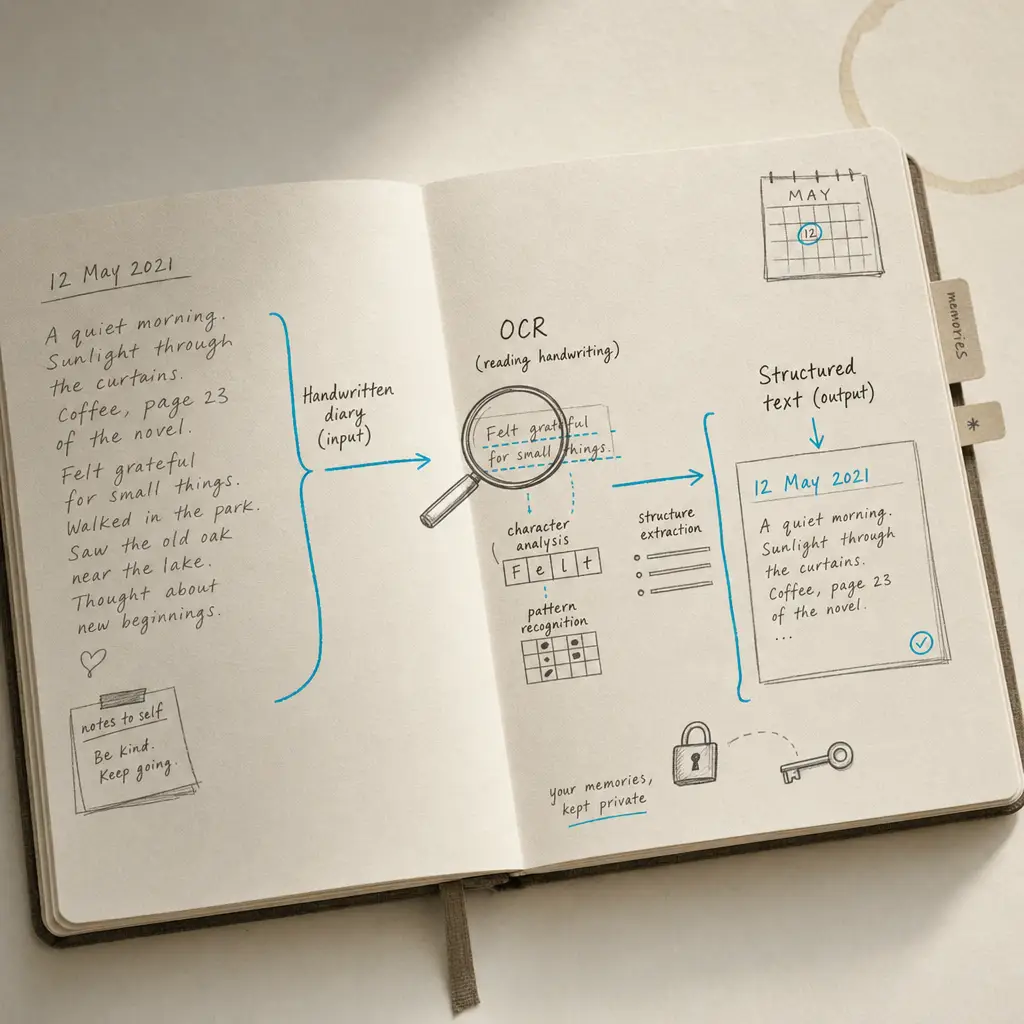
Handwriting OCR processes the handwritten text portions while preserving document structure. When a diary page contains both a handwritten entry and a pasted newspaper clipping, the system extracts the handwritten text. Researchers still need the original images to see the complete page with its additions, but the handwritten portions become searchable.
Many journals include the diarist’s own sketches, maps, or diagrams. These visual elements remain as images, but when they’re accompanied by handwritten labels or descriptions, those text elements can be extracted and searched.
Photographs and Scans of Fragile Documents
Original diaries are often too fragile for repeated handling. Genealogists photograph pages during archive visits or carefully scan family documents at home. These images vary in quality depending on lighting, equipment, and the physical condition of the original.
Handwriting OCR works with these real-world photographs and scans. It handles variations in lighting that create shadows or uneven illumination. It processes images captured at slight angles when flat scanning wasn’t possible. It adapts to different camera phones, flatbed scanners, and photography setups rather than requiring specialized equipment.
This practical approach matters for family history work. Researchers photograph diary pages during brief archive visits or scan fragile family documents at home. They shouldn’t need perfect scanning conditions or expensive equipment to make these materials searchable.
What to Expect: Capabilities and Limitations
Understanding what handwriting OCR can realistically accomplish with personal diaries helps set appropriate expectations. This technology accelerates specific research tasks but doesn’t eliminate the need for careful reading and genealogical interpretation.
The table below shows typical performance across common diary and journal characteristics:
| Document Characteristics | What Works Well | What May Need Review |
|---|---|---|
| Well-preserved journals with clear handwriting | Routine daily entries, dates, names of people and places | Personal abbreviations, names spelled phonetically, context-dependent references |
| Multiple decades in one person’s handwriting | Earlier entries when handwriting was stronger | Later entries affected by age, health issues, or deteriorating vision |
| Travel journals and voyage diaries | Dates, locations, ship names, companion names | Place names in foreign languages, unfamiliar geographical references |
| War diaries and military journals | Dates, locations, unit references, fellow soldiers’ names | Military abbreviations, technical terminology, censored or coded passages |
| Pocket diaries with brief entries | Weather notes, work descriptions, visitor names, significant events | Heavy abbreviations, telegraphic writing style, minimal context |
| Emotional or private journals | Narrative passages, reflective writing, story-like entries | Stream of consciousness writing, heavily emotional passages, very informal language |
What It Handles Well
Handwriting OCR converts handwritten diary entries into searchable, editable text. This means you can search decades of journals for every mention of a specific person, locate all entries from a particular time period, or find references to a specific place or event without reading every page.
It processes photographs and scans from various sources and equipment. Whether you photographed diary pages during an archive visit, scanned a family journal at home, or received digital images from a relative, the system handles the variation in image quality and format.
Document chronology and structure are maintained where the original had clear organization. If entries are dated, those dates remain associated with their text. If the journal has clear section breaks or formatting, that structure carries through to the extracted text.
The technology makes long journals manageable for research. A diary spanning forty years might fill dozens of volumes and thousands of pages. Reading every page thoroughly is valuable but time-consuming. Having searchable text allows targeted searching followed by careful reading of relevant passages in their original context.
What Requires Manual Verification
Personal abbreviations and shorthand are extracted as written, not automatically expanded. Family historians familiar with a diarist’s writing conventions can identify these patterns in the searchable text, but the technology doesn’t interpret meaning beyond extracting what appears on the page.
Unclear personal references need genealogical context for interpretation. If a diarist mentions “Aunt Sarah’s daughter who married the widower from town,” extracting that text makes it searchable, but determining who these people were requires genealogical research and family knowledge.
Handwriting severely affected by age, illness, or emotional distress may be more difficult to process accurately. If passages are barely legible even when examining the original carefully, automated recognition will struggle as well. These sections benefit from technology, but they require patient verification against the original images.
Entries that mix languages or include words in scripts the diarist was learning present additional challenges. A diary might contain mostly English but include German phrases, Latin quotations, or attempts at writing in a foreign script. These mixed-language passages may need closer review.
The goal is research acceleration, not perfect automation. Handwriting OCR handles the time-consuming work of making handwritten text searchable so researchers can spend their time on interpretation, verification, and connecting diary evidence to other genealogical sources.
Where This Fits in Family History Research
Handwriting OCR addresses specific challenges genealogists face when working with personal diaries and journals. It’s not a replacement for reading the original documents carefully. It’s a tool for making large volumes of handwritten material searchable and accessible.
How family historians use handwriting OCR with diaries and journals:
-
Searching for specific people across decades of entries: Convert multi-volume journals to searchable text and locate every mention of a particular ancestor, relative, or family friend. This is particularly valuable when trying to understand relationships, track someone’s health or activities over time, or find scattered references that together tell a story. Rather than reading forty years of daily entries hoping not to miss a name, search the digitized text and then read those specific entries in their original context.
-
Locating events and dates for timeline building: Extract dates and events from journal entries to build detailed family timelines that complement official records. A diary might mention births, deaths, illnesses, moves, and social events that don’t appear in formal documents. Searchable text makes it possible to find these references and correlate them with census years, migration patterns, or historical events.
-
Preserving family narratives for sharing: Create searchable digital versions of family journals that can be shared with relatives researching the same family lines. Rather than transcribing entire volumes by hand, process them with OCR and then carefully review and annotate the output. This makes precious family documents accessible to distant relatives who can’t handle fragile originals.
-
Connecting diary evidence to other genealogical sources: Use searchable journal text to verify or clarify information from census records, ship manifests, or vital records. When a diary mentions “the year we moved to Chicago” or “when sister Mary married that farmer,” you can search for these references and then check them against official records for dates and details.
-
Researching immigrant and migration experiences: Process travel diaries, immigration journey narratives, and settlement journals to extract details about the migration experience. These personal accounts often name ships, traveling companions, initial residences, and early employment that help track families during transitional periods poorly documented in official records.
-
Documenting women’s and children’s experiences: Make journals by women and children searchable to preserve voices often underrepresented in official records. These documents provide essential context for family history, describing household management, child-rearing, education, social networks, and daily life that don’t appear in male-dominated official documents.
-
Analyzing daily life patterns across time periods: Create searchable records of routine activities, seasonal work patterns, and community interactions to understand the context in which ancestors lived. Rather than just knowing someone was a farmer from a census record, their diary might reveal detailed seasonal work patterns, crop failures, weather events, and community cooperation that explain migration decisions or economic circumstances.
The pattern across these uses is targeted searching followed by careful contextual reading. Technology makes journals searchable. Researchers apply genealogical knowledge to interpret what they find, verify it against other sources, and build coherent family narratives.
Privacy and Sensitivity Considerations
Personal diaries often contain intimate information, family conflicts, private thoughts, and sensitive material. Making these documents searchable and shareable requires thoughtful consideration of privacy and family sensitivities.
Handwriting OCR processes documents privately. Your family diaries are processed only to deliver results to you. They are not used to train AI models, not shared with other users or third parties, and not retained longer than necessary to complete processing. This matters particularly for personal documents that might contain private family information.
You maintain control over what gets shared. Just because a diary is digitized and searchable doesn’t mean all of it needs to be shared with extended family or published online. You can use the searchable text for your own research while being selective about what you share more broadly.
Some genealogists process entire diaries for searchability but share only selected passages with family members, respecting the diarist’s privacy while making historically significant information accessible. Others create annotated versions where private or potentially hurtful passages are noted but not transcribed.
Consider the diarist’s intent and the feelings of living relatives. A great-grandmother’s diary from the 1940s might contain opinions about family members whose children or grandchildren are still living. The historical value of the document doesn’t eliminate the need for sensitivity about how and with whom it’s shared.
The technology provides tools for preservation and access. Genealogists make thoughtful decisions about how to use those tools responsibly.
Getting Started
If you’re working with family diaries or journals and wondering whether handwriting OCR would help your research, the most direct approach is to test it with actual pages from your documents.
Handwriting in personal diaries varies dramatically. What works well for a carefully kept daily journal might perform differently with hastily written pocket diary entries. The only way to know if handwriting OCR will help with your specific family documents is to try it with representative pages.
Handwriting OCR offers a free trial with credits you can use to process sample pages. Photograph or scan a few representative pages from a family diary, upload them, and review the output. See how it handles your ancestor’s handwriting, personal abbreviations, and writing style.
Choose test pages that represent the range of handwriting quality in the document. If handwriting changed significantly over the diary’s span, test both earlier and later entries. If some sections are more legible than others, test both types. This gives you realistic expectations about performance across the entire document.
Your documents remain private throughout this process. They’re processed only to deliver results to you and are not used to train models or shared with anyone else. This is particularly important for personal family documents that may contain sensitive or private information.
The process is straightforward. Upload your photographs or scans, process them, and download the results as editable text in Word, Markdown, or plain text format. You can then review the output against the original images, correct any errors, and determine whether continuing to process the entire diary would save you time compared to manual transcription.
If the output quality meets your needs for the sample pages, it will likely work well for similar pages throughout the diary. If it doesn’t meet your accuracy requirements, you’ve learned that before investing time in processing entire volumes. Either way, you’ll have a clearer understanding of whether handwriting OCR fits your approach to preserving and researching family journals.
For more context about using OCR technology with genealogical research materials, see the comprehensive guide to genealogy handwriting OCR.
Frequently asked questions
Can handwriting OCR accurately read personal diaries that span decades with changing handwriting?
Handwriting OCR is designed to handle variation in handwriting over time, including the changes that occur as someone ages or as their health changes. It processes each section based on the handwriting characteristics present, rather than expecting consistency throughout a multi-decade journal. However, accuracy depends on the legibility of the original handwriting. Well-preserved pages with reasonably clear writing process more reliably than severely degraded sections or passages where age or illness made handwriting very difficult to read. The best approach is to test with sample pages from different time periods in your specific diary to see how it performs across the document's span.
Will handwriting OCR automatically decode personal abbreviations and shorthand used in diaries?
No. Handwriting OCR extracts what is actually written on the page, not what it might mean. If a diarist consistently abbreviated "Wednesday" as "Wed." or used initials for family members, the output will show those abbreviations as written. This is actually valuable for research because it preserves the diarist's writing conventions. You'll need to apply your knowledge of the person's writing style and family context to interpret abbreviations, but having them in searchable text makes it easier to identify patterns and locate all instances of specific shorthand.
How do I handle diaries that contain both handwriting and other items like photos, clippings, and pressed flowers?
Handwriting OCR processes the handwritten text portions of diary pages while preserving the overall document structure. Items like photographs, newspaper clippings, or pressed flowers remain as visual elements. You'll still need the original images or scans to see these additions in context, but the handwritten text around them becomes searchable. This is how most genealogists work with digitized diaries, keeping the original scans or photographs while using the extracted text for searching and reference.
Can I share digitized family diaries with relatives while maintaining privacy?
Yes. Creating a searchable digital version doesn't mean you must share everything. Many genealogists process family diaries for their own research use, then selectively share relevant passages with extended family rather than distributing the entire document. You maintain control over what you share. The technology simply makes it easier to search the document yourself, extract specific passages for sharing, or create curated versions that respect both historical preservation and family privacy concerns.
What if my ancestor's diary is too fragile to scan repeatedly but I can photograph it once?
Handwriting OCR works with photographs taken with phone cameras or digital cameras, not just flatbed scans. If you can carefully photograph each diary page once during a session with a fragile document, those photographs can be processed. The system handles variations in lighting and image quality that come from photography rather than scanning. Many genealogists photograph fragile family diaries specifically to avoid repeated handling of originals, then work exclusively with the digital photographs for both reading and OCR processing.