
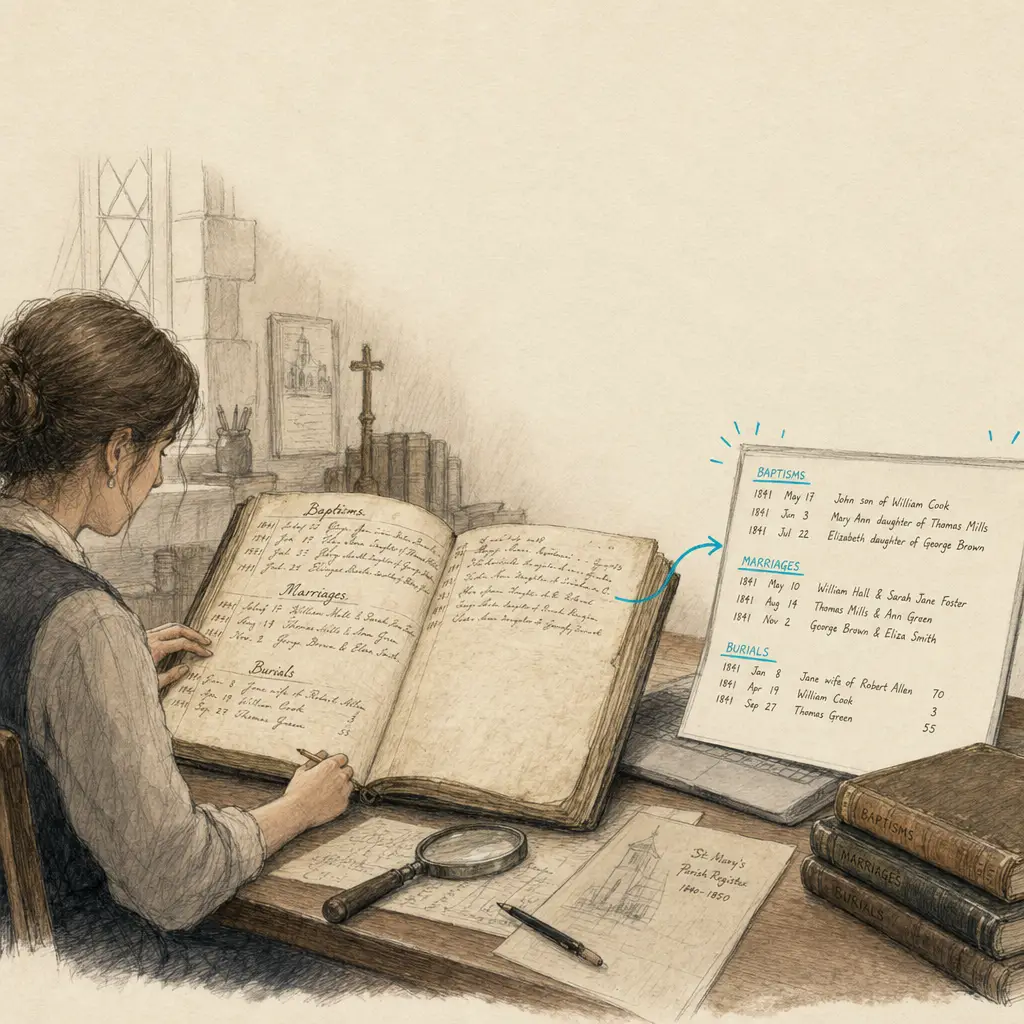
Quick Takeaways
- Handwriting OCR can process parish registers from different denominations, time periods, and clergy handwriting styles
- It converts handwritten baptism, marriage, and burial entries into searchable text for faster genealogical research
- Produces editable output that you can search across multiple years of registers, copy into research databases, and organize systematically
- Works with scanned images from archives, churches, FamilySearch, or personal photographs without requiring format conversion
- Manual verification is important for names, dates, and Latin phrases, but the technology accelerates the process of making church records accessible
Parish registers form one of the most important sources for genealogical research, particularly for periods before civil registration began. These church records document baptisms, marriages, and burials, often extending back centuries. For family historians, parish registers provide crucial evidence for vital events, confirm relationships between family members, and establish family presence in specific communities across generations.
But accessing the information in parish registers typically means working through handwritten entries page by page. Most genealogists know the experience of reviewing years of register entries, checking each baptism for children of your ancestor’s family, scanning marriage records for mentions of familiar surnames, and searching burial registers for evidence of when and where family members died.
Even when parish registers are digitized and available through platforms like FamilySearch, Ancestry, or diocesan archives, they exist as scanned images. You can view them, but you can’t search within the handwritten text itself. Some registers have partial indexes created by volunteers, but many remain completely unindexed. When working with unindexed registers or verifying questionable index entries, you’re left with manual page-by-page review of handwriting that may be centuries old.
This creates research friction that every parish register researcher recognizes. You spend hours reading through register entries written in various hands by different clergy across decades. You manually transcribe baptism, marriage, and burial information into spreadsheets or research notes. You can’t quickly search your collected register images for all mentions of a particular surname or family connection because the handwritten text isn’t searchable.
This page explains what handwriting OCR can and cannot do for parish register research. It’s not about replacing careful source analysis or eliminating the need to understand church record conventions. It’s about understanding whether this type of tool can accelerate the mechanical work of extracting text from register images so you can spend more time on genealogical interpretation and less time on manual transcription.
Why Parish Registers Present OCR Challenges
Historical parish registers were maintained by clergy as part of their ecclesiastical duties, creating documents with characteristics that make automated text extraction challenging.
Register handwriting varies by clergy member, denomination, and time period. Some vicars and priests maintained meticulous registers with clear, careful handwriting. Others made hasty entries with abbreviated information and cramped writing. A single parish might have registers maintained by dozens of different clergy members across centuries, meaning handwriting style changes frequently throughout the records.
Different time periods used different recording practices and languages. Early parish registers often recorded events in Latin, using standardized ecclesiastical phrases and abbreviations. Later registers transitioned to vernacular languages but retained some Latin conventions. The amount of detail recorded varied by period and denomination—some entries contain extensive family information, while others provide only minimal details.
Register formats evolved over time. Early registers might intermix baptisms, marriages, and burials on the same pages with minimal organization. Later registers used separate sections or volumes for each type of event with more standardized column formats. Some parishes maintained separate registers for different denominations or social classes.
Physical deterioration affects many surviving registers. Parish registers stored in church vaults or damp conditions may have water damage, faded ink, or pages damaged by handling across centuries. Microfilm copies of fragile registers introduce grain and contrast variations. Digital scans vary in quality depending on when and how they were created and the condition of the original register being scanned.
Characteristics that make parish register OCR challenging:
- Variable clergy handwriting: Different vicars, rectors, and priests with different handwriting quality across decades or centuries
- Latin phrases and abbreviations: Ecclesiastical language, standardized formulas, and clerical shorthand
- Evolving recording practices: Changes in what information was recorded and how it was organized
- Mixed entry formats: Baptisms, marriages, and burials sometimes intermixed on the same pages
- Age and deterioration: Faded ink, water damage, and physical degradation from centuries of storage
- Historical handwriting styles: Changing penmanship conventions across different time periods
- Marginal annotations: Later additions, corrections, or notes added by subsequent clergy
What Handwriting OCR Can Extract from Parish Registers
Handwriting recognition technology designed for historical documents approaches parish registers differently than standard OCR. It’s built to handle the variable handwriting, Latin text, historical formats, and preservation challenges typical of actual church record research.
Baptism Record Information
For baptism registers, handwriting OCR extracts the core information: the child’s name, baptism date, parents’ names, and residence or origin information. Many baptism registers also include godparents, legitimacy status, or birth dates in addition to baptism dates.
This conversion to searchable text means you can search extracted baptism registers for all children born to parents with specific surnames, locate baptisms in particular years, or find godparent relationships that might indicate family connections. You can copy baptism information directly into genealogy software without manual retyping.
The technology adapts to different baptism register formats, from simple chronological lists to detailed columnar arrangements with extensive family information.
Marriage Record Details
Marriage registers typically contain the names of both parties, the marriage date, their residences or parishes, and often witnesses or consent information. Later registers may include ages, occupations, fathers’ names, and marital status.
Handwriting OCR extracts this information, making it searchable across years of marriage records. You can search for all marriages involving a particular surname, find marriages where specific witnesses appeared, or locate couples who married in particular time periods.
The technology handles different marriage register conventions, from banns registers to separate marriage ceremony records, adapting to the structure of each register type.
Burial Record Data
Burial registers record the deceased person’s name, burial date, age or approximate age, and sometimes residence or place of death. Some registers include cause of death, occupation, or family relationship information.
Converting burial registers to searchable text allows you to search for all burials of people with specific surnames, identify burial clusters that might indicate family groups, or locate burials in particular age ranges that might match missing family members.
The technology processes burial registers from different time periods, handling both sparse early entries and more detailed later records.
Latin Text and Ecclesiastical Phrases
Many early parish registers use Latin for recording vital events, employing standardized ecclesiastical phrases and abbreviations. Handwriting OCR processes Latin text, extracting names, dates, and relationship information even when surrounded by Latin formulas.
While the technology extracts the Latin text as written, you’ll benefit from understanding common Latin genealogical phrases to interpret the extracted records accurately. But having the text extracted and searchable is considerably faster than manually transcribing Latin entries.
Multiple Clergy Hands
Parish registers maintained across decades or centuries contain entries from many different clergy members. Each incumbent brought their own handwriting style, recording preferences, and level of detail.
Handwriting OCR handles these variations by processing each section based on its own characteristics rather than expecting uniform style throughout the register. This adaptability matters when working with registers that span long time periods with multiple clergy changes.
Marginal Notes and Annotations
Parish registers often contain marginal notes, later additions, or corrections made by subsequent clergy members. These annotations might record later marriages, deaths of baptized children, or corrections to original entries.
The technology extracts visible text including marginal content, though you’ll need to distinguish between original entries and later annotations during verification. This is actually valuable because it preserves information that might otherwise be overlooked.
What to Expect: Accuracy and Limitations
Understanding what handwriting OCR handles well and where it needs verification helps set realistic expectations for parish register research applications. This isn’t technology that eliminates the need for paleography skills or knowledge of church record conventions. It’s a tool that accelerates text extraction so you can focus on genealogical interpretation.
The table below shows typical performance with different parish register elements:
| Register Element | What Works Well | What Requires Verification |
|---|---|---|
| Names | Common surnames, repeated family names in the parish | Unusual spellings, names in Latin form, patronymic variations |
| Dates | Clearly written numerical dates, month abbreviations | Dates written in words, old calendar systems, damaged or faded date entries |
| Places | Parish locations, standard residence descriptions | Foreign place names, obsolete parish names, abbreviated locality descriptions |
| Latin phrases | Standard ecclesiastical formulas that repeat | Complex Latin clauses, heavily abbreviated phrases, mixed Latin and vernacular |
| Relationships | Standard relationship terms (father, mother, spouse) | Complex family relationships, informal designations, abbreviated references |
| Occupations | Common occupations repeated across entries | Obsolete occupation names, specialized clerical terms, abbreviated trades |
What Handwriting OCR Handles Well
Standard baptism, marriage, and burial information that follows established register formats processes reliably. When clergy members maintained consistent recording practices with clear handwriting, the extracted text quality reflects that consistency.
Repeated names and surnames throughout a register benefit from pattern recognition. When a family had multiple children baptized in the same parish over several years, the repeated surname appearance helps the technology recognize it accurately across entries.
Clearly written entries from clergy with legible handwriting produce accurate extractions. Some register keepers wrote more carefully than others, and when the source handwriting is clear, the extracted text quality improves accordingly.
Latin formulas and phrases that repeat throughout registers are handled well because the standardized wording creates recognizable patterns. Common baptism phrases like “baptizatus est” or marriage formulas appear consistently enough for accurate extraction.
What Requires Manual Verification
Name spellings benefit from researcher verification, especially for surnames. Parish clerks sometimes recorded names as they heard them, meaning spellings could vary across different entries for the same family. The OCR extracts what’s actually written, but you’ll need to apply genealogical judgment about whether spelling variations refer to the same family.
Latin text requires knowledge of ecclesiastical Latin to interpret accurately. While the technology extracts Latin phrases and abbreviations, understanding what they mean for genealogical purposes requires familiarity with church record conventions. Resources like “Latin for Local and Family Historians” help interpret extracted Latin text.
Dates need contextual verification, especially when working with registers that span calendar reforms or use feast days rather than numerical dates. A date recorded as “in festo Sancti Michaelis” (on the feast of St. Michael) needs conversion to the modern calendar date.
Heavily abbreviated entries or clerical shorthand may not expand automatically. If a clerk consistently abbreviated “baptizatus” as “bapt” or used personal shorthand for common terms, the extracted text preserves those abbreviations as written.
Damaged or faded sections will produce less reliable output. When original register pages have water damage, faded ink, or physical deterioration that makes entries barely visible to human eyes, automated recognition struggles as well. These sections benefit from processing—you may get partial text that provides clues—but they require careful verification against the original image.
The goal is acceleration, not automation. Handwriting OCR handles the mechanical task of text extraction from parish register images. Researchers apply their expertise in paleography, church record conventions, and local history to verify accuracy and interpret the genealogical significance of the extracted information.
How Parish Register Researchers Use Handwriting OCR
Handwriting OCR addresses specific bottlenecks in church record research workflows. It’s not a replacement for understanding parish boundaries, ecclesiastical jurisdictions, or church record conventions. It’s a tool for removing friction from the process of extracting and organizing register information.
Common parish register research applications:
Systematic Parish Register Review
When researching families in a specific parish across multiple decades, you need to review years of baptism, marriage, and burial entries looking for all mentions of family surnames. Handwriting OCR converts entire register sections to searchable text, allowing you to search for surname variations rather than visually scanning every entry.
This is particularly valuable when working with unindexed registers where no existing index guides you to relevant entries. You can process complete register years and then search systematically for family references rather than relying on visual page-by-page review.
Multi-Parish Family Tracking
Families often moved between neighboring parishes or had relationships spanning multiple church jurisdictions. Tracking a family across different parish registers requires extracting information from baptism registers in one parish, marriage registers in another, and burial registers in a third.
Rather than manually transcribing entries from multiple parish registers, you can process relevant sections from each register and extract the text directly. This accelerates the process of building comprehensive family timelines that span different parishes.
Identifying Family Networks
Parish registers contain information about godparents, witnesses, and relationships that help identify extended family networks. Processing baptism registers gives you searchable text containing godparent names for multiple families. Processing marriage registers provides witness information that might reveal family connections.
You can search extracted register text for all instances where specific people appeared as godparents or witnesses, identifying relationship networks that aren’t immediately obvious from isolated register entries.
Reconstructing Families in Context
One-place studies and local history research often involve systematically working through all baptisms, marriages, and burials in a parish to reconstruct the entire community. Processing complete parish registers creates searchable text covering the whole parish population.
You can then search for occupational patterns, identify naming patterns across families, track migration in and out of the parish, and analyze demographic patterns that require access to all register entries, not just those relating to specific surname interests.
Creating Searchable Research Archives
When you’ve collected register images from multiple parishes relevant to your family research, processing them creates a searchable personal archive. You can then search your entire collection for specific surnames, relationships, or family patterns rather than remembering which parish register and which year contains the information you need.
This is particularly valuable for researchers with deep ancestry in specific regions who work with registers from numerous parishes across a county or diocese.
Verifying Existing Indexes
Some parish registers have volunteer-created indexes, but these may contain transcription errors or miss entries entirely. When you find an index entry that doesn’t quite match your known family information, processing the actual register page gives you searchable text to verify the indexed information against the handwritten original.
You can search the extracted text for surname variations the index might have missed, check dates for accuracy, and identify family relationships that might have been simplified or omitted from index records.
Integration with Church Record Research Workflows
Handwriting OCR fits into existing parish register research workflows as a text extraction tool rather than replacing established genealogical practices. Understanding where it fits helps determine whether it addresses bottlenecks you actually experience.
Typical workflow integration:
- Locate relevant parish registers using online catalogs, FamilySearch, Ancestry, or diocesan archives
- Download or photograph register page images from digital archives or during archive visits
- Process register images through handwriting OCR to extract text
- Verify extracted information against the original images, checking names, dates, and relationships
- Interpret Latin phrases and ecclesiastical abbreviations using reference materials
- Copy verified data into genealogy software, spreadsheets, or research databases
- Search extracted text for surnames, relationships, or patterns across multiple register years
- Cite sources properly in your research, referencing the original parish register not the extracted text
The technology handles step 3, accelerating text extraction. The other steps remain researcher work that requires knowledge of church records, paleography, and genealogical analysis.
For researchers working extensively with unindexed parish registers, the time savings can be substantial. Instead of manually transcribing hundreds of baptism, marriage, and burial entries, you extract the text and spend your time on verification and genealogical interpretation.
For researchers who primarily use well-indexed parish registers, the value is more situational. When you need to verify index accuracy, identify witness or godparent relationships, or analyze complete parish populations rather than isolated family entries, handwriting OCR provides capabilities you wouldn’t otherwise have without extensive manual transcription.
Getting Started with Parish Register OCR
If you’re working with parish registers and wondering whether handwriting OCR would accelerate your research, the most direct approach is to test it with actual register pages from your current research.
Parish register handwriting varies by denomination, country, time period, and individual clergy member. An 18th-century Anglican baptism register from an English rural parish looks different from a 19th-century Catholic marriage register from an Irish town. The only way to know if handwriting OCR will help with your specific parish register research is to try it with the kinds of registers you actually work with.
Handwriting OCR offers a free trial with credits you can use to process sample register pages. Download a baptism register page you’ve been meaning to transcribe, a section from an unindexed marriage register, or a burial register where you want to verify index accuracy. Process it and compare the extracted text to what you’d get from manual transcription.
Your parish register images remain private throughout this process. They’re processed only to deliver results to you and are not used to train models or shared with anyone else. Church records often contain personal information, and privacy is built into the service design.
The process is straightforward. Upload your parish register page image or PDF, process it, and download the results as editable text in formats that work with your research workflow (Word, Markdown, plain text, or structured data formats). There’s no software installation, no technical setup, and no commitment required to test whether it works for your register documents.
If it saves you time on the register pages you tested, it will likely save time on similar materials in your research. If it doesn’t meet your accuracy needs for specific time periods, clergy handwriting styles, or register conditions, you’ve learned that before investing further. Either way, you’ll have a clearer understanding of where handwriting OCR fits in parish register research workflows.
For broader context on how handwriting OCR works across different genealogical document types beyond parish registers, see our main page on genealogy and family history handwriting OCR.
Frequently asked questions
Can handwriting OCR accurately read parish registers written in Latin?
Yes. Handwriting OCR processes Latin text in parish registers, extracting names, dates, and ecclesiastical phrases. Many early parish registers used standardized Latin formulas for baptisms, marriages, and burials, and these repeated phrases help the technology recognize them accurately. However, you'll need familiarity with ecclesiastical Latin to interpret the extracted text correctly. The technology extracts what's written, but understanding phrases like "baptizatus est" (was baptized) or "in matrimonium conjuncti sunt" (were joined in marriage) requires knowledge of church record conventions. Resources like Latin genealogical dictionaries help interpret the extracted Latin text.
Will handwriting OCR work with parish register images from FamilySearch, Ancestry, or diocesan archives?
Yes. Handwriting OCR processes parish register images regardless of their source. If you can download a register page image from FamilySearch, Ancestry, diocesan websites, or county archives, you can process it. The system handles various image qualities and formats, including downloads from online catalogs, scans from microfilm, or photographs of registers taken during archive visits. No format conversion or special preparation is required before processing.
How does handwriting OCR handle parish registers where different clergy members had very different handwriting?
Handwriting OCR processes each section of a parish register based on its own characteristics rather than expecting uniform handwriting throughout. Parish registers maintained across decades or centuries contain entries from many different vicars, rectors, and priests, each with their own handwriting style. The technology adapts to these variations, processing entries from careful, legible clergy and rushed, abbreviated hands within the same register. Some clergy handwriting will process more accurately than others, reflecting the original legibility, but the system doesn't require consistent handwriting throughout a register to function.
Can I use handwriting OCR to create searchable databases of baptism, marriage, and burial records for a parish?
Yes. Many parish register researchers use handwriting OCR specifically for this purpose. By processing baptism, marriage, and burial registers from a parish, you create searchable text that you can organize into databases or spreadsheets. You can then search across years or decades of register entries for specific surnames, identify godparent or witness patterns, or analyze demographic information about the parish population. This is particularly valuable for one-place studies, local history projects, or comprehensive family reconstruction that requires systematic access to all parish register entries rather than isolated lookups.
Does using handwriting OCR mean my parish register images are sent to third parties or used to train AI models?
No. Your parish register images remain private and are processed only to deliver results to you. They are not used to train AI models, not shared with third parties, and not retained longer than necessary to complete processing. This is particularly important for church records that may contain personal information or come from archives with usage restrictions. Privacy is built into the service design as a fundamental principle, not an optional feature.