
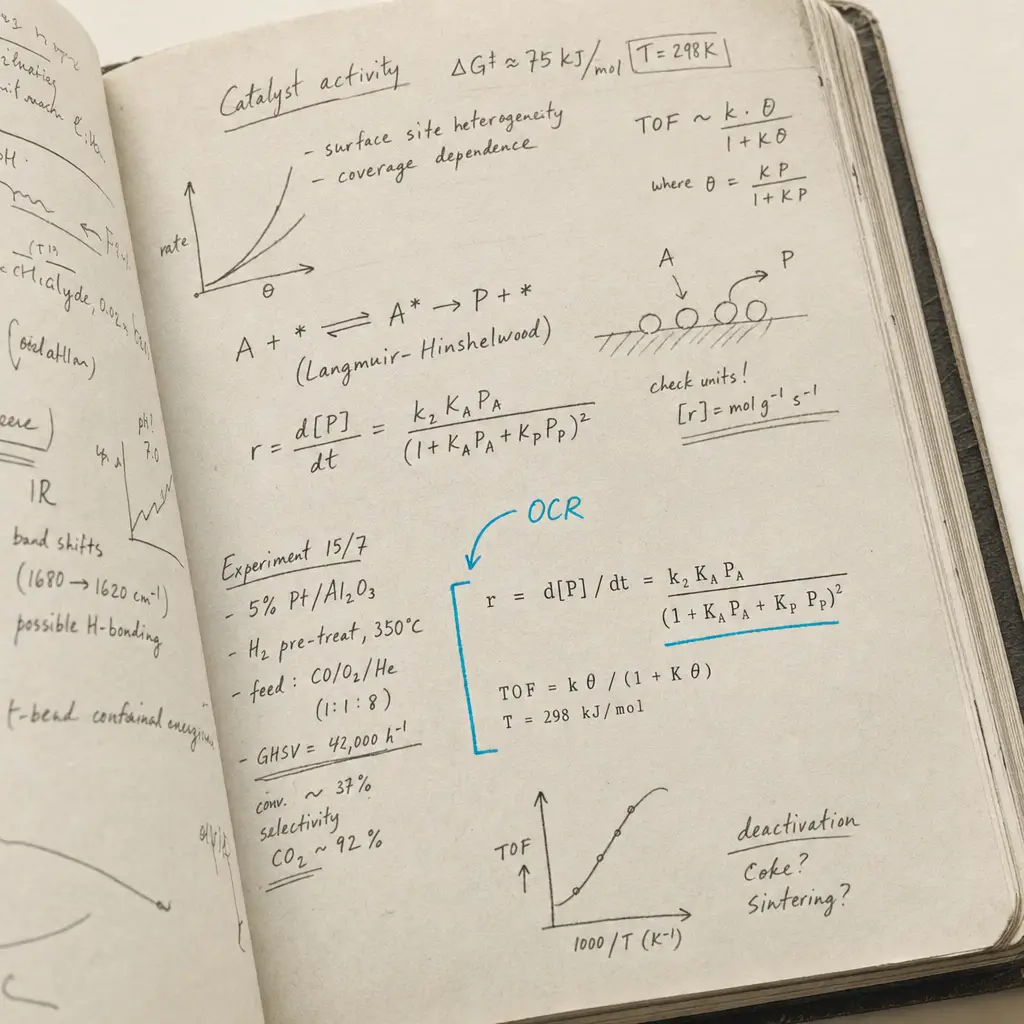
You’ve spent years filling laboratory notebooks with observations, measurements, and insights. Now you need to find that one experiment from three years ago, or compile data from multiple field seasons. You know it’s in there somewhere, but flipping through hundreds of pages takes hours you don’t have.
Research notebooks hold the detailed record of your work, from initial observations to final conclusions. But when that information exists only on paper, it’s effectively invisible to digital search tools and increasingly difficult to share with collaborators.
Handwriting OCR solves this problem by converting your handwritten research notes into searchable digital text. Instead of manual searching through physical notebooks, you can find any observation, measurement, or note in seconds.
Quick Takeaways
- Research notebooks contain irreplaceable handwritten observations accumulated over years or decades
- Manually searching for specific data points across multiple notebooks wastes valuable research time
- Handwriting OCR converts your notes into searchable digital text while preserving the original content
- Digitization protects against physical deterioration, loss, and enables seamless collaboration
- Modern OCR handles scientific notation, equations, diagrams, and varied handwriting styles
The Hidden Cost of Handwritten Research Notebooks
Physical research notebooks served science well for centuries. Charles Darwin’s field notebooks and Albert Einstein’s theoretical notebooks are now digitized and accessible online because their historical value justified the effort. Your research notebooks may not end up in the British Library, but they hold similar value for your work and your field.
Time Lost Searching for Data
The average researcher spends significant time looking for information they know exists in their notebooks. You remember recording an observation, but not which notebook or which month. Manual searching means reading through pages of notes, hoping you recognize the entry when you see it.
This inefficiency compounds when you need to compile data from multiple experiments or field seasons. What should take minutes with digital search instead takes hours of physical page-turning.
Manually locating specific data points in historical lab notebooks is inefficient and time-consuming.
Risk of Physical Deterioration and Loss
Paper degrades. Ink fades. Notebooks get damaged by water, lost during office moves, or simply wear out from repeated handling. Some of Marie Curie’s laboratory notebooks remain so radioactive they require protective clothing to handle, making them effectively inaccessible without digitization.
Laboratory notebook scanning has become standard practice for protecting research data, but scanning alone doesn’t make the content searchable. A PDF image of handwritten notes is only slightly more useful than the physical notebook unless you add OCR.
Collaboration Barriers
When your notes exist only on paper, sharing them means physical transfer, photocopying, or scanning individual pages. Electronic lab notebooks prevent data loss when researchers move on, but most existing research lives in handwritten notebooks that predate digital systems.
Research groups need to build on previous work. Staff turnover in laboratories can lead to duplication of experiments or loss of institutional knowledge simply because earlier observations remain locked in physical notebooks.
What Makes Research Notebooks Challenging to Digitize
Research notebooks aren’t like personal diaries with flowing narrative text. They contain mixed content that presents unique challenges for digitization.
Mixed Content Types
A typical research notebook page might include:
- Handwritten observations and measurements
- Chemical formulas and scientific notation
- Quick sketches and diagrams
- Data tables with multiple columns
- References to other experiments or literature
- Margin notes and annotations
Standard OCR tools designed for printed text struggle with this variety. They might handle the text portions but fail on equations, skip over diagrams entirely, or misinterpret tables.
Variable Handwriting Quality and Scientific Notation
Not every researcher has neat handwriting. Field notes might be written in challenging conditions. Laboratory notes often include specialized symbols, subscripts, and superscripts that standard OCR wasn’t designed to recognize.
Handwriting recognition technology must handle diverse handwriting styles, overlapped text lines, and the specific notation conventions of scientific writing.
Volume and Time Span
PhD students and career researchers accumulate multiple notebooks over years or decades. A comprehensive digitization project might involve thousands of pages spanning different handwriting styles as your writing evolved over time.
The volume makes manual transcription impractical. Typing even a single page by hand can take 15 to 20 minutes. Multiply that across hundreds or thousands of pages, and you’re looking at weeks of full-time work.
How Handwriting OCR Works for Research Notebooks
Modern handwriting OCR uses AI models trained specifically on handwritten text, including scientific notation and varied handwriting styles. The technology has advanced significantly beyond the character recognition tools that only worked on printed text.
Processing Different Content Types
Advanced OCR systems can handle the mixed content typical of research notebooks. The technology recognizes handwritten text alongside equations, preserves table structures, and identifies diagram locations even if it can’t interpret the drawings themselves.
Your documents remain private throughout this process. The files are processed only to deliver your results and are not used to train models or shared with anyone else.
Preserving Scientific Accuracy
For researchers, accuracy matters more than speed. A misread measurement or chemical formula could invalidate your ability to replicate an experiment. Quality OCR for laboratory notes prioritizes accuracy, especially for scientific notation and numerical data.
The output isn’t perfect, which is why reviewing results remains important. But starting with OCR-generated text that captures most of your content accurately is far faster than typing everything from scratch.
| Manual Transcription | OCR Processing |
|---|---|
| 15-20 minutes per page | Seconds per page |
| Requires full attention | Allows batch processing |
| Linear time investment | Quick initial pass, focused review |
Making Your Research Searchable
The real value emerges when your handwritten notes become searchable text. Instead of remembering which notebook contains information about a specific gene or field site, you search across all your digitized notebooks simultaneously.
This searchability transforms how you can use your own research data. Finding related observations across different experiments becomes straightforward. Compiling data for publications or grant applications gets faster.
From Scanning to Searchable: The Digitization Process
Converting your research notebooks into searchable digital text involves several steps, but the process is more straightforward than you might expect.
Preparing Your Notebooks
You don’t need specialized equipment. Most researchers use smartphone apps or physical scanners to create images of their notebook pages. Some outsource scanning to specialized companies that handle fragile documents carefully.
The key is producing clear, readable images. Good lighting and flat pages produce better OCR results than shadowy photos of curved pages. Higher resolution captures more detail, which helps with small handwriting or faint ink.
Upload and Processing
Once you have scanned images, you upload them to an OCR service. The system processes each page, converting handwritten text into digital text while maintaining the logical structure of your notes.
For sensitive research data, privacy protections matter. HandwritingOCR processes your documents only to deliver your results. Your files remain yours, and nothing is reused or stored longer than necessary.
Your research data remains private and is processed only to deliver your results.
Reviewing and Organizing Results
After processing, you review the converted text. This step catches any recognition errors and lets you verify that scientific notation and measurements were captured correctly.
You can then organize the searchable text however works best for your workflow. Some researchers maintain the text alongside scanned images. Others import it into reference management systems or electronic lab notebooks. The digital format gives you flexibility the physical notebook never could.
Practical Applications for Researchers
Searchable research notebooks solve real problems that researchers face throughout their careers.
Data Management and Compliance
Funding agencies increasingly require data management plans. Institutions need documentation of research methods. Digitized, searchable notebooks make compliance straightforward instead of burdensome.
When grant reviewers or collaborators ask about specific methodological details, you can find and share the relevant notebook entries immediately. You’re no longer limited to what you remember or can locate quickly in physical notebooks.
Publication and Grant Requirements
Writing papers often requires compiling observations from multiple experiments conducted over months or years. With searchable notebooks, you find all relevant entries for a specific method, specimen, or measurement series in minutes.
The same capability helps when responding to reviewer comments that ask for additional methodological detail or when preparing grant applications that build on preliminary data.
Knowledge Transfer and Lab Continuity
When students graduate or researchers move to new positions, their detailed observations and troubleshooting notes represent valuable institutional knowledge. Digitized notebooks preserve this information for future lab members in a format they can actually use.
New students can search previous work for similar experiments, understand what methods worked or failed, and build on established protocols. The knowledge doesn’t leave when people do.
Making Your Research Accessible
Research notebooks document the scientific process in detail that published papers can’t capture. They hold the observations, null results, and methodological notes that inform future work.
Keeping that information locked on paper limits its value. Manual searching wastes time. Physical degradation risks permanent loss. Collaboration and knowledge transfer remain unnecessarily difficult.
Handwriting OCR transforms handwritten research notebooks into searchable digital archives. Your years of observations become instantly accessible. Your data stays protected from physical loss. Your detailed notes remain available for future work, whether by you or by others building on your research.
The technology handles scientific notation, varied handwriting, and mixed content types. Your documents remain private throughout processing. The result is searchable text that preserves your research while making it far more useful than paper ever could.
Try HandwritingOCR with free credits to see how your research notebooks convert to searchable text.
Frequently asked questions
Can handwriting OCR handle scientific equations and notation in research notebooks?
Yes, modern handwriting OCR can process scientific equations, chemical formulas, and specialized notation commonly found in research notebooks. While accuracy may vary depending on handwriting clarity and notation complexity, the technology is specifically designed to handle mixed content including text, numbers, symbols, and equations. You should review the converted results to verify that critical formulas and measurements were captured correctly.
How accurate is OCR for handwritten laboratory notes and field notebooks?
OCR accuracy for handwritten research notebooks typically delivers strong results for reasonably clear handwriting. Accuracy depends on factors like handwriting consistency, ink quality, and page condition. This level of performance means you'll need to review and correct some errors, but you're starting with mostly correct text rather than typing everything manually. For research purposes where precision matters, always verify critical measurements, formulas, and observations.
What happens to my research data when I use handwriting OCR services?
Your research notebooks remain private and are processed only to deliver your converted text results. Your data is not used to train AI models or shared with third parties. Documents are not retained longer than necessary to complete processing. This matters particularly when working with sensitive or unpublished research data.
Can I make decades of old research notebooks searchable with OCR?
Yes, you can digitize and make searchable even very old research notebooks, provided the pages are in readable condition. OCR works on scanned images of notebook pages regardless of when they were written. The main challenges with older notebooks are physical deterioration, faded ink, or inconsistent handwriting styles that evolved over time. Higher-quality scans help improve OCR accuracy for older documents.
Is it faster to use OCR or manually transcribe research notebook pages?
OCR is significantly faster than manual transcription for processing research notebooks. Manual transcription typically takes 15-20 minutes per page of handwritten notes, while OCR processes pages in seconds. The time investment shifts from typing everything to reviewing and correcting OCR output, which is much faster. For large volumes like multiple notebooks or years of research, OCR reduces what would be weeks of typing to hours of review work.