
Quick Takeaways
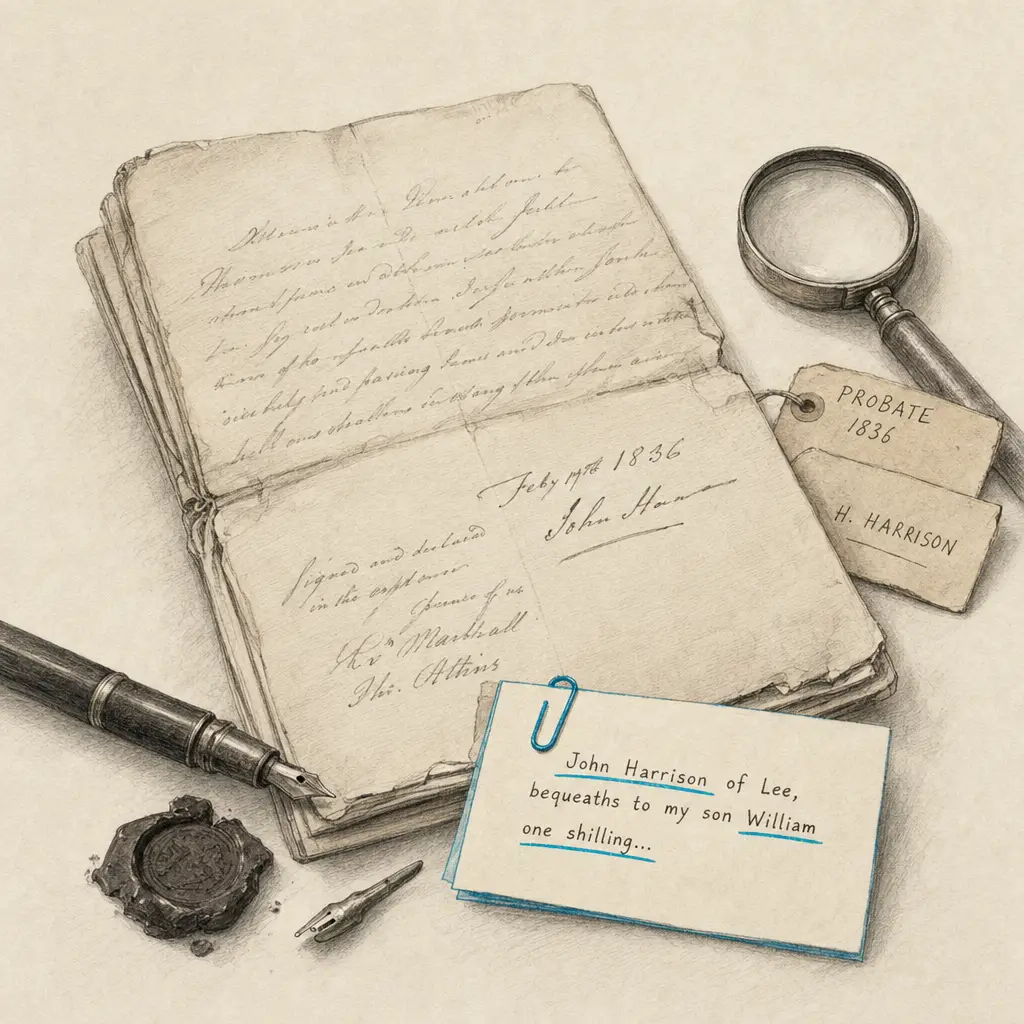
- Handwriting OCR processes handwritten wills and probate documents to create searchable text for identifying family relationships
- It’s designed to handle legal handwriting, historical cursive, and the mixed formats common in estate records
- Produces editable text that makes it easier to find beneficiaries, property descriptions, and relationship statements
- Works with scanned probate files from archives and genealogy websites without special preparation
- Manual verification remains important, but the technology accelerates finding family connections in lengthy legal documents
Probate records and wills provide genealogical evidence that appears nowhere else. Unlike census records that show who lived together at one moment in time, wills document deliberate decisions about relationships and property. A will names beneficiaries, identifies family members, describes property, and sometimes explains relationships in ways that clarify complex family structures.
For genealogists, probate documents answer specific questions. Who were the testator’s children? Did they have siblings not mentioned in other records? Were there stepchildren or children from previous marriages? What property did the family own? Who served as executor, often a trusted relative? These details help reconstruct families when other records are ambiguous or missing.
But probate records present research challenges. Estate files can span dozens or hundreds of pages. Handwritten wills may be entirely in cursive. Probate proceedings include petitions, inventories, account books, and correspondence, all potentially handwritten by different people. Finding the specific genealogical information within these lengthy documents requires careful page-by-page review.
Even when probate records are digitized and available through online archives or genealogy websites, they’re typically scanned images. You can view them, but you can’t search for names within the handwritten text. A will that mentions ten children and describes property across multiple pages must be read in its entirety to extract family information.
This page explains what handwriting OCR can and cannot do for probate research from a genealogical perspective. It’s not about legal practice or estate administration. It’s about understanding whether this tool can help family historians extract relationship information from wills and probate documents more efficiently.
Why Probate Records Matter for Genealogy
Wills and probate documents solve genealogical problems that other records can’t address. Understanding what makes them valuable helps explain why making them searchable matters.
Probate records identify children by name when other records only count them. A census might show “4 children in household” without naming them. A will names each child individually and often describes their circumstances. This specificity helps when vital records are missing or when you need to distinguish between children with common names.
Estate documents reveal complex family structures. Second marriages, stepchildren, children from previous marriages, adopted children, and illegitimate children acknowledged by the family all appear in probate records. A will might leave property to “my son John and his half-sister Mary” or mention “the children of my late wife’s first marriage.” These relationship clarifications appear in legal documents precisely because property distribution required clarity about family structure.
Wills document daughters’ married names. Women who married between census records can be difficult to trace. A will leaving property “to my daughter Sarah Johnson, formerly Sarah Smith” provides the connection that proves identity across name changes.
Probate records identify extended family relationships. When someone dies without direct descendants, wills often name nieces, nephews, cousins, or more distant relatives as beneficiaries. These connections help extend family trees and identify collateral lines.
Estate inventories describe property that indicates social and economic status. While not strictly genealogical, knowing whether ancestors owned land, enslaved people, businesses, or specific possessions provides context for understanding their lives and circumstances.
What genealogists find in probate records:
- Named beneficiaries: Children, spouses, grandchildren, and other relatives identified by name and relationship
- Relationship clarifications: Explicit descriptions of stepchildren, half-siblings, in-laws, and complex family connections
- Married names: Daughters and female relatives identified by married name with maiden name references
- Property descriptions: Real estate, personal property, and assets that indicate family circumstances
- Executor information: Trusted family members or associates chosen to administer estates
- Witness signatures: Neighbors and community members who witnessed wills, often indicating social networks
- Settlement documents: Division of property among heirs showing who actually received inheritances
- Timeline information: Death dates, filing dates, and settlement periods that help establish chronology
Challenges Specific to Probate Documents
Handwritten wills and probate records present specific challenges that differ from other genealogical documents. Understanding these helps set realistic expectations for automated text extraction.
Legal documents used formal language and terminology. Testators and lawyers employed legal phrasing, Latin terms, and formulaic language typical of estate documents. Phrases like “bequeath and devise,” “residuary estate,” “heirs and assigns,” and “in witness whereof” appear throughout wills and probate proceedings. This formal language adds complexity beyond everyday correspondence.
Wills were often written or copied by lawyers, clerks, or court officials. Professional legal handwriting could be meticulous and clear, or it could be rushed legal script full of abbreviations and flourishes. Some wills exist as holographic (entirely handwritten by the testator) documents in the testator’s personal handwriting. Others are clerk copies in legal hand. The handwriting style depends on who created the specific document.
Probate files combine multiple document types. A complete estate file might include the original will in one handwriting, petitions in another, inventories compiled by appraisers, account books maintained by executors, correspondence between lawyers, and court orders written by clerks. Each document potentially represents different handwriting, and all might be relevant to genealogical research.
Historical probate records span centuries of legal practice. A will from 1750 looks different from one from 1850 or 1920. Legal formats, terminology, and handwriting conventions changed over time. Probate research across multiple generations means encountering these variations.
Document preservation varies widely. Some probate records exist in well-maintained courthouse archives. Others survived in courthouse fires, floods, or moves only as damaged copies. Some exist only as microfilm or early digital scans of questionable quality. The condition of available records affects what can be extracted.
Specific challenges in probate document OCR:
- Legal terminology and phrasing: Formal language, archaic legal terms, and Latin phrases
- Variable professional handwriting: From careful legal script to rushed clerk’s abbreviations
- Multi-document files: Different handwriting styles within a single estate file
- Historical format variations: Changing legal conventions across time periods
- Mixed printed and handwritten forms: Pre-printed court forms filled in by hand
- Marginal notes and amendments: Codicils, annotations, and later additions
- Property descriptions: Technical land descriptions with surveys, metes and bounds
What Handwriting OCR Can Extract from Probate Records
Handwriting recognition technology designed for historical documents approaches probate records as complex legal materials containing genealogical information. It’s built to handle the formal language, legal handwriting, and document variations typical of actual estate files.
Beneficiary Names and Relationships
The genealogical core of most wills is the list of beneficiaries and their relationships to the testator. Handwriting OCR extracts this information so it becomes searchable. Instead of reading through entire wills looking for mentions of specific names or relationships, you can search extracted text for family surnames, relationship terms like “son,” “daughter,” “grandchild,” or “nephew,” and beneficiary identifications.
This searchability accelerates the process of identifying all family members mentioned in a will. You can quickly locate sections that describe specific relationships, verify that you’ve identified all named beneficiaries, and extract relationship statements for your research notes.
Property Descriptions and Bequests
Wills describe property left to beneficiaries. While primarily legal information, property descriptions provide genealogical context. Real estate descriptions indicate where families lived. Personal property bequests sometimes include sentimental items that indicate relationships or family history.
Searchable text makes it possible to find all property references, identify patterns in how property was distributed among children, and locate descriptions that provide clues about family circumstances.
Executor and Witness Information
Executors and witnesses appear in wills and probate documents. These individuals were typically trusted associates, family members, or community connections. Identifying them helps understand family networks and social relationships.
Handwriting OCR extracts these names so you can search for mentions of specific individuals who might have served as executors or witnesses across multiple family wills. This helps identify patterns in family relationships and community ties.
Legal Proceedings and Timeline
Probate files include petitions, court orders, and administrative documents that establish timeline information. When was the will filed? When was the estate settled? When did specific distributions occur? These dates help establish chronology and sometimes provide indirect evidence about family circumstances.
Searchable text makes it easier to extract dates and timeline information from lengthy probate files without reading every administrative document in sequence.
Multiple Documents Within Estate Files
Complete probate files may include wills, codicils (amendments), inventories of property, account books showing estate administration, correspondence about the estate, and settlement documents. Each document may contain genealogically relevant information.
Handwriting OCR processes these varied documents, creating searchable text across the entire estate file. This enables searching the complete probate proceeding for family information rather than being limited to the will itself.
What to Expect: Accuracy and Limitations
Understanding what handwriting OCR handles well and where it needs verification helps set realistic expectations for probate research applications. This isn’t technology that eliminates the need for careful reading and source verification. It’s a tool that accelerates finding genealogical information within legal documents.
The table below shows typical performance with different probate document elements:
| Probate Element | What Works Well | What Requires Verification |
|---|---|---|
| Beneficiary names | Common surnames, repeated family names | Unusual name spellings, abbreviated given names, married vs. maiden names |
| Relationship terms | Standard terms (son, daughter, wife, grandson) | Complex relationships (stepdaughter of my late wife, nephew by marriage) |
| Property descriptions | Clearly written land descriptions, personal property lists | Abbreviated property terms, archaic measurement units, technical survey language |
| Legal terminology | Repeated standard phrases and terms | Latin phrases, archaic legal language, jurisdiction-specific terms |
| Dates | Written-out dates, numerical dates | Roman numerals, archaic date formats, regnal years |
| Executor names | Full names clearly written | Abbreviated titles, complex professional designations |
What Handwriting OCR Handles Well
Standard beneficiary lists process reliably. When a will lists children by name with straightforward relationship descriptions, the extraction captures these essential genealogical facts. You can search for specific surnames, relationship terms, and combinations that identify family members.
Repeated legal phrases and terminology benefit from pattern recognition. Because wills use formulaic language, phrases that appear multiple times across documents or within a single document help the system recognize terminology accurately.
Clearly written professional legal handwriting produces good results. Court clerks and lawyers who wrote carefully and legibly created documents that process well. When the source handwriting is clear, extracted text quality reflects that clarity.
Complete, well-preserved documents extract more reliably than damaged or partial records. Probate files that survived intact in courthouse archives typically provide better source material than documents that suffered damage or exist only as poor-quality copies.
What Requires Manual Verification
Complex relationship descriptions need careful review. When a will describes “the children of my deceased son John and his widow Margaret” or “my stepdaughter from my late wife’s first marriage,” the relational complexity requires genealogical interpretation even when words are extracted accurately.
Name variations benefit from researcher knowledge. If a beneficiary is listed as “Sarah Johnson formerly Sarah Smith” or “my son John, also known as Jack,” the genealogist must make the connection. The OCR extracts the words, but family identification requires researcher judgment.
Property descriptions containing technical terminology or abbreviations may need contextual understanding. Historical land measurement terms, survey references, and property descriptions using local conventions require interpretation beyond text extraction.
Legal language and Latin terms should be verified against the original. While common legal phrases process well, archaic legal terminology or Latin phrases might be captured imperfectly and should be checked against scanned images.
Marginal notes, amendments, and codicils need careful attention. When wills were amended or had later additions, these modifications are crucial for genealogical accuracy. Make sure amendments are identified and their relationship to the original will is clear.
The goal is acceleration of research, not elimination of source analysis. Handwriting OCR handles the mechanical task of text extraction from probate documents. Genealogists apply their expertise to interpret relationships, verify accuracy, and build family reconstructions based on probate evidence.
How Genealogists Use Probate Document OCR
Handwriting OCR addresses specific bottlenecks in probate research workflows for family historians. It’s not a replacement for careful reading and analysis of wills. It’s a tool for making lengthy probate files more accessible and extracting family information more efficiently.
Common genealogical applications for probate OCR:
Identifying All Named Family Members
Wills sometimes mention numerous relatives across multiple pages. Rather than risk missing a family member mentioned late in the document or in a codicil, processing the entire will creates searchable text where you can search for all relationship terms, verify you’ve identified everyone mentioned, and extract complete beneficiary lists systematically.
This is particularly valuable with lengthy wills that describe complex family structures or mention extended family members in various contexts throughout the document.
Finding Daughters’ Married Names
One of the most valuable genealogical uses of probate records is identifying daughters’ married names. Processing wills and searching for relationship terms like “daughter” helps locate these identifications. You can then extract the exact phrasing showing both married and maiden names.
This application alone can solve research problems that might otherwise require years of searching for missing daughters who married between census records.
Clarifying Complex Family Relationships
Second marriages, stepchildren, and blended families create genealogical complexity. Wills often explicitly describe these relationships because property distribution required clarity about family structure.
Searchable probate text enables finding these relationship clarifications. You can search for terms like “stepson,” “half-sister,” “children of my late wife,” or “children of my former marriage” to identify complex family connections that might not be obvious from other records.
Verifying Children’s Names and Order
Census records show children at specific points in time but may miss children who died young, married and left home, or were born between censuses. Wills listing “all my children” provide verification.
Processing wills creates searchable text where you can extract complete children’s lists, verify names and order, and identify children who might not appear in census records.
Finding Extended Family Connections
When someone died without direct descendants, wills naming nieces, nephews, cousins, or more distant relatives provide crucial connections for extending family trees.
Searchable probate text makes it possible to search for these extended family mentions. You can look for specific surnames known to be related, search for relationship terms indicating collateral lines, and identify previously unknown family connections.
Building Probate Research Databases
Genealogists researching communities or family lines often work with multiple related probate files. Processing these documents creates a searchable collection that can be searched across multiple wills.
You can identify patterns in how property passed through generations, find all wills where specific individuals appear as beneficiaries or executors, and track family connections across multiple estate settlements.
Creating Research Extracts
Professional genealogical research often requires creating accurate extracts from probate documents for clients or publication. Rather than manually transcribing lengthy wills, processing them and extracting relevant sections maintains accuracy while accelerating the extraction process.
The extracted text can be verified against originals, ensuring quotes and transcriptions are accurate, and reducing time spent on mechanical transcription work.
Integration with Probate Research Workflows
Handwriting OCR fits into existing probate research workflows as a text extraction tool, not a replacement for genealogical analysis. Understanding where it fits helps determine whether it addresses research bottlenecks you actually experience.
Typical workflow integration:
- Locate probate records through courthouse archives, online databases, FamilySearch, Ancestry, or genealogy websites
- Download or save probate document images including wills, petitions, inventories, and related files
- Process documents through handwriting OCR to extract searchable text from handwritten records
- Search extracted text for names, relationships, property descriptions, and genealogical information
- Verify findings against original images checking accuracy of names, relationships, and key facts
- Extract verified information into genealogy software, research databases, or family tree documentation
- Cite sources properly referencing original probate records, not just extracted text
- Analyze relationship information applying genealogical reasoning to interpret family structures
The technology handles step 3 and accelerates step 4. The other steps remain researcher work requiring genealogical knowledge, legal record understanding, and careful source analysis.
For genealogists working with extensive probate research across multiple family lines, the time savings can be substantial. Instead of manually reading dozens of lengthy wills page by page, you extract text and spend time on verification and analysis.
For researchers who occasionally consult probate records, the value is more targeted. When you encounter a particularly lengthy will, a complex family structure requiring careful analysis, or multiple related probate files that might reference the same individuals, handwriting OCR provides capabilities that accelerate specific research challenges.
Getting Started with Probate Document OCR
If you’re working with handwritten wills and probate records and wondering whether handwriting OCR would help your genealogical research, the most direct approach is to test it with actual probate documents from your research.
Probate handwriting varies by time period, jurisdiction, and whether documents were written by testators, lawyers, or court clerks. An 1850s handwritten will looks different from a 1920s typed will with handwritten signatures and amendments. The only way to know whether handwriting OCR will help with your specific probate research is to try it with the kinds of documents you actually work with.
Handwriting OCR offers a free trial with credits you can use to process sample probate documents. Select a handwritten will from your research, a probate petition with genealogical information, or an estate inventory listing family members. Process it and evaluate whether the extracted text captures the beneficiary names, relationships, and genealogical details you need.
Your probate documents remain private throughout this process. They’re processed only to deliver results to you and are not used to train models or shared with anyone else. Family estate records contain personal information about property and relationships, and privacy is fundamental to the service design.
The process is straightforward. Upload your probate document image or PDF, process it, and download the results as searchable text in formats that work with your research workflow (Word, Markdown, plain text). No software installation, no technical setup, and no commitment required to test whether it works for your probate documents.
If it saves you time on the probate documents you tested, it will likely save time on similar materials in your research. If it doesn’t meet your accuracy needs for your specific time period or handwriting styles, you’ve learned that before investing further. Either way, you’ll have a clearer understanding of where handwriting OCR fits in probate research workflows.
For broader context on how handwriting OCR works across different genealogical document types beyond probate records, see our main page on genealogy and family history handwriting OCR.
Frequently asked questions
Can handwriting OCR read handwritten wills from the 1800s and early 1900s?
Yes, handwriting OCR is designed to process historical wills including those written in the cursive legal handwriting common in 19th and early 20th century probate documents. It handles both holographic wills entirely in the testator's handwriting and clerk-copied wills in professional legal script. Accuracy depends on the clarity of the original handwriting, whether the will was professionally written or personally drafted, and the preservation condition. Well-preserved wills with relatively clear handwriting typically process well. The best way to assess performance on wills from your specific research time period is to test with sample documents from your collection.
Will handwriting OCR work with probate records downloaded from FamilySearch, Ancestry, or courthouse archives?
Yes. Handwriting OCR processes probate record images regardless of their source. If you can download a will, probate petition, or estate inventory from FamilySearch, Ancestry, online courthouse databases, or genealogy websites, you can process it. The system handles various image qualities and formats, including digital archive downloads, scanned probate files, or photographs of courthouse records. No format conversion or special preparation is required before processing.
How does handwriting OCR handle complex family relationships described in wills like stepchildren or half-siblings?
Handwriting OCR extracts the relationship descriptions as they appear in the will. If a testator writes "to my stepdaughter Sarah from my late wife's first marriage" or "to my son John and his half-brother James," the system captures these exact phrases. The extracted text preserves the relationship language, making it searchable, but you'll need to apply genealogical reasoning to interpret how these relationships fit into your family structure. The technology handles text extraction; genealogical interpretation and family reconstruction remain researcher work.
Can I use handwriting OCR to search multiple related probate files for family connections?
Yes. When researching a family line or community, you often work with multiple related wills and probate files. By processing all these documents, you create a searchable collection where you can search across multiple estates for specific surnames, relationship terms, or individuals who appear as beneficiaries or executors in various wills. This helps identify family connections, track property through generations, and spot patterns in estate settlements across related families. The searchable text makes it practical to work with extensive probate collections that would be impractical to read manually in their entirety.
Are my family probate documents kept private when using handwriting OCR services?
Yes. Your probate documents remain private and are processed only to deliver text extraction results to you. They are not used to train AI models, not shared with third parties, and not retained longer than necessary to complete processing. Probate records contain personal information about family property, relationships, and estate details. The service is designed to respect the confidential nature of these family documents, treating them with appropriate privacy regardless of their historical age.