
Quick Takeaways
- Handwriting OCR converts handwritten estate inventories into searchable, editable spreadsheets and documents
- Processes asset lists with property descriptions, valuations, and executor notes
- Works with historical inventories and contemporary estate documentation
- Handles mixed handwriting styles from multiple contributors
- Manual verification remains essential for financial accuracy and legal compliance
Estate inventories are foundational documents in probate administration. They catalog what the decedent owned, establish values for estate tax purposes, and create the basis for distribution to beneficiaries. Yet these critical documents are often handwritten—sometimes by executors working through a home filled with possessions, sometimes by appraisers documenting items one by one, sometimes by multiple people adding entries as assets are discovered over months of administration.
The result is hundreds of handwritten entries describing furniture, jewelry, real estate, financial accounts, personal effects, and business interests. Each item needs a description detailed enough to identify it uniquely. Each needs a valuation supported by documentation. Each needs to be searchable when beneficiaries ask questions, auditors request details, or courts require accountings.
When inventories exist only as handwritten documents, this creates friction throughout estate administration. You can’t search for specific items without reading every page. You can’t update valuations without rewriting sections. You can’t easily share portions with beneficiaries without photocopying entire documents. Every modification means more manual transcription.
This page explains what handwriting OCR can and cannot do with estate inventories. It’s about understanding whether this technology addresses real bottlenecks in your estate administration process, what realistic outcomes look like, and where it fits in workflows that demand both accuracy and efficiency.
For broader context on handwriting OCR in estate practice, see Probate, Wills & Estate Handwriting OCR.
Why Estate Inventories Are Still Handwritten
Despite the availability of digital tools, estate inventories remain handwritten in many situations. Understanding why helps clarify what kinds of documents handwriting OCR needs to handle.
On-Site Documentation During Estate Administration
Executors and estate administrators often create inventories on-site while walking through the decedent’s home, storage facilities, or business locations. They document items as they encounter them, writing descriptions by hand because it’s faster and more practical than carrying a laptop or typing on a phone while moving through rooms full of possessions.
This handwritten documentation captures immediate observations about condition, location, and identifying characteristics that might be forgotten later. The executor notes that a dining table has a damaged leg, that jewelry was found in a specific drawer, or that business records were stored in the attic. These contextual details matter for valuation and distribution decisions.
Multiple Contributors Adding Entries Over Time
Estate inventories aren’t created in one sitting. Initial inventories document obvious assets. Subsequent discoveries add items found in safe deposit boxes, storage units, or forgotten locations. Professional appraisers contribute valuation notes. Asset specialists add descriptions of technical items like machinery, vehicles, or equipment.
Each contributor uses their own handwriting. Each adds entries at different times. The result is an inventory with mixed handwriting styles, varying levels of detail, and entries created over weeks or months of administration. Consolidating these handwritten additions into a single searchable document becomes increasingly important as the inventory grows.
Historical Inventories in Estate Files
Historical estate files contain inventories created decades ago when handwritten documentation was standard practice. These inventories document assets that may have been distributed long ago, but they remain relevant for ongoing trust administration, family property research, or estates where assets were never properly distributed.
When you need to verify what was included in a parent’s estate twenty years ago, when researching whether specific property was properly distributed, or when handling estates where previous administration was incomplete, these historical inventories provide essential documentation. But only if they can be accessed and searched efficiently.
Appraisers’ Handwritten Valuation Notes
Professional appraisers often document items by hand during initial site visits. They note condition issues, comparable sales, market factors, and preliminary valuations while examining items directly. These handwritten notes become part of the formal appraisal process and need to be incorporated into estate inventories.
The handwriting quality varies depending on the appraiser’s working conditions. Notes written while examining furniture in a crowded room look different from valuations written carefully at a desk. But both types of documentation need to be captured, searchable, and available for future reference.
Common sources of handwritten content in estate inventories:
- Personal property inventories: Room-by-room lists of household contents, furniture, artwork, and personal effects documented during estate administration
- Asset valuation worksheets: Handwritten appraisal notes documenting condition, comparable sales, and estimated values for estate items
- Real property descriptions: Handwritten details about land parcels, improvements, condition issues, and valuation factors for estate real estate
- Business asset inventories: Lists of equipment, inventory, receivables, and intangible assets from decedent-owned businesses
- Financial account summaries: Handwritten lists consolidating bank accounts, investment holdings, retirement accounts, and other financial assets
- Discovered asset additions: Later entries documenting items found after initial inventory, requiring integration into existing estate records
What Makes Estate Inventories Challenging for OCR
Estate inventories present specific challenges that standard OCR systems can’t address. Understanding these challenges explains why specialized handwriting recognition technology is necessary.
Mixed Handwriting from Multiple Contributors
Unlike documents written by a single person, estate inventories often contain entries from executors, appraisers, family members, and professional advisors. Each contributor writes differently. Handwriting quality varies from careful, legible penmanship to rushed notes scribbled while balancing paperwork in uncomfortable positions.
Standard OCR assumes consistent formatting and uniform text. When it encounters an inventory page with three different handwriting styles, each describing items with different levels of detail, using different abbreviations and organizational approaches, it fails to produce usable output. The mixed handwriting that makes estate inventories practical to create is exactly what makes them impossible for traditional OCR to process.
Technical Terminology and Item Descriptions
Estate inventories contain specialized vocabulary that standard OCR systems aren’t designed to recognize. Antique furniture pieces have specific period designations and style names. Jewelry descriptions include gemstone terminology and precious metal specifications. Real estate descriptions use legal property terminology. Collectibles require specialized classification systems.
When handwritten, these technical terms become particularly challenging. An appraiser’s handwritten note about “Art Deco marquetry console” or “14K white gold filigree setting” uses vocabulary that must be recognized accurately for the inventory to be useful. Misreading these terms compromises the inventory’s value for asset distribution and tax purposes.
Numbers, Values, and Financial Data
Handwritten numbers are notoriously difficult for OCR systems. In estate inventories, where accuracy of financial values is legally significant, this becomes a critical limitation. A valuation of $15,000 misread as $18,000 creates problems for estate accounting. Lot numbers, item quantities, and date values must be captured exactly.
The challenge intensifies when numbers appear alongside descriptive text in varied formats. Some appraisers write values clearly with dollar signs and commas. Others abbreviate with “K” for thousands or use shorthand that requires context to interpret correctly. Inventory pages might show estimated ranges, preliminary values pending appraisal, or multiple valuations from different dates.
Marginalia and Amendments
Estate inventories accumulate handwritten notes as administration progresses. Initial valuations get updated. Items marked for specific beneficiaries receive handwritten annotations. Condition issues discovered later generate marginal notes. Executors add cross-references to supporting documentation.
These handwritten additions don’t follow neat organizational patterns. They appear in margins, between lines, or as arrows connecting related items. They use abbreviations and references that make sense to the person who wrote them but require context to interpret. Capturing this layered information accurately requires recognition technology specifically designed for real-world document complexity.
What Handwriting OCR Does with Estate Inventories
Handwriting recognition designed for variable handwriting approaches estate inventories as the complex, multi-contributor documents they actually are. Rather than expecting uniform formatting, it’s built to handle the reality of estate administration documentation.
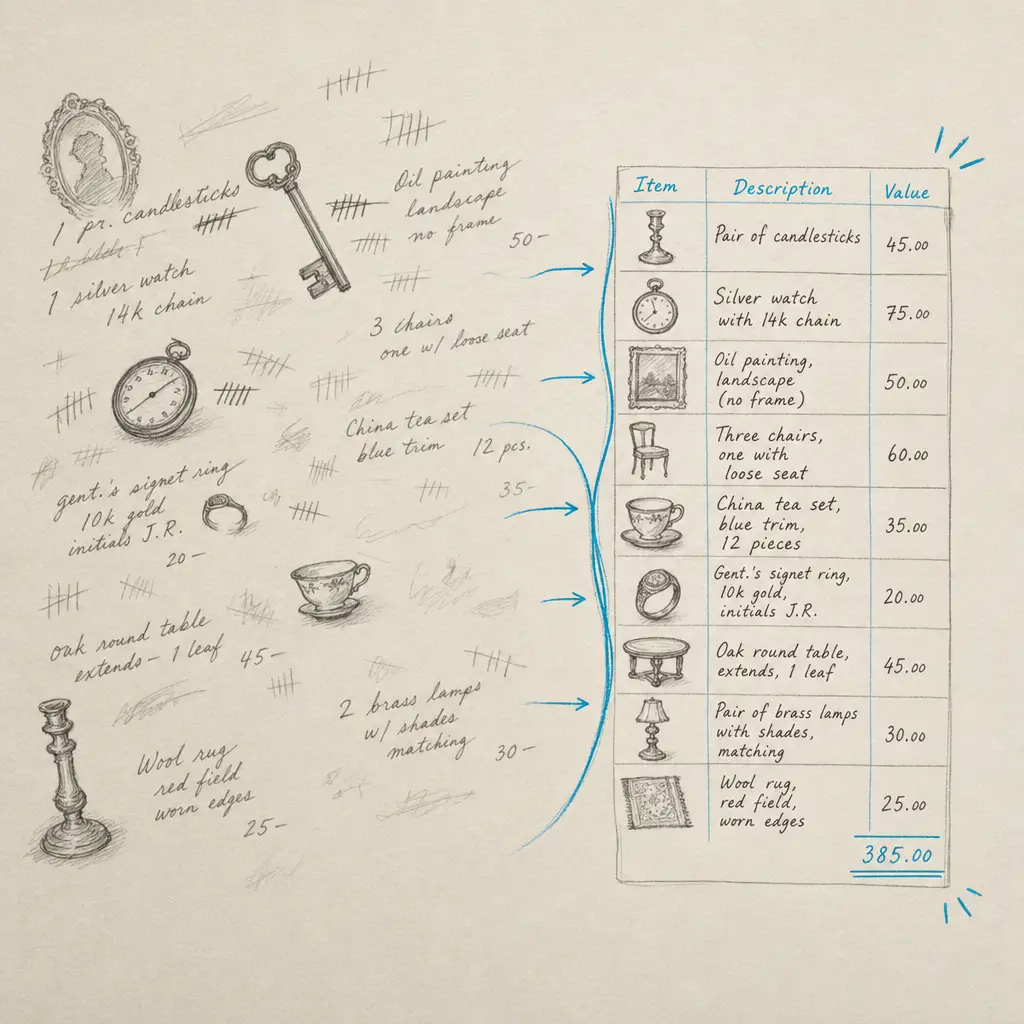
Structured Data Extraction from Handwritten Lists
Estate inventories typically follow a list structure even when handwritten. Items are numbered or organized by category. Descriptions follow items. Values appear in consistent positions. This structure provides patterns that handwriting OCR can recognize and preserve.
The system extracts handwritten inventory entries and maintains their structure. Item numbers, descriptions, and valuations remain associated correctly. Category headers stay distinct from individual items. The output preserves the organizational logic of the original inventory even though it was written by hand.
This means you can convert a handwritten inventory into a searchable spreadsheet where each item becomes a row with columns for description, value, location, and notes. You can sort by category, search for specific items, and update valuations without rewriting the entire document.
Handling Multiple Handwriting Styles
Because estate inventories often contain entries from different contributors, handwriting OCR is designed to process mixed handwriting styles on the same page. It doesn’t assume a single consistent writing style throughout the document.
This flexibility matters for real estate inventories where the executor provides basic descriptions, an appraiser adds valuation details in different handwriting, and beneficiaries contribute handwritten notes about items they’re claiming. Each layer of handwriting can be processed without requiring the document to be separated into sections by author.
The output indicates which sections are in different handwriting where this distinction is clear and relevant. For legal purposes, knowing which portions were added later or written by specific contributors can matter for establishing valuation dates or identifying who made particular assertions about items.
Processing Financial Values and Numbers
Handwriting OCR includes specific capabilities for recognizing handwritten numbers because financial documents require this functionality. In estate inventories, this means processing valuations, item quantities, dates, and account numbers that appear throughout the documentation.
The system is designed to recognize common financial notation including dollar signs, comma separators, decimal points, and abbreviations like “K” for thousands. It handles numbers appearing in various contexts—as standalone valuations, within descriptions, or as part of account identifiers.
However, verification remains important. Just as you would verify manually transcribed financial data, handwritten valuations extracted through OCR should be spot-checked against source documents, particularly for high-value items where accuracy directly affects tax liability and beneficiary distributions.
Capturing Marginalia and Amendments
The system processes handwritten additions in margins and between lines, recognizing that amendments and annotations are meaningful content, not noise to be filtered out. When executors add notes about condition issues, when appraisers update preliminary valuations, or when beneficiary selections are written next to items, these additions become part of the searchable record.
This is particularly valuable for estate inventories that evolve over months of administration. Rather than maintaining multiple versions or losing track of updates made in different handwriting at different times, you have a single searchable document that captures the full history of inventory development.
What to Expect: Accuracy for Estate Inventory Documents
Understanding realistic expectations for handwriting OCR with estate inventories helps you determine whether this technology fits your workflows and accuracy requirements.
The table below shows typical performance across common estate inventory scenarios:
| Inventory Type | What Works Well | What Requires Verification |
|---|---|---|
| Personal property lists | Room-by-room descriptions, furniture categories, basic item identification | Ambiguous item descriptions, unclear handwritten numbers or quantities |
| Appraisal valuations | Clearly written values, professional appraiser notes, comparative analysis | Handwritten ranges or estimates, preliminary valuations marked for update |
| Real estate details | Property addresses, basic descriptions, location notes | Technical legal descriptions, complex survey references, abbreviated terminology |
| Financial accounts | Account types, institution names, approximate values | Specific account numbers, exact balances, routing information |
| Business assets | Equipment lists, inventory categories, general descriptions | Technical specifications, model numbers, serial number sequences |
What It Handles Reliably
Estate inventories with clear handwriting and reasonable organization process well. When executors take time to write legibly, when appraisers provide structured notes, and when the overall document follows a consistent format, the output is highly usable with minimal correction needed.
Item descriptions written in complete sentences or standard phrases extract accurately. Common furniture terms, jewelry descriptions, and standard asset categories that appear frequently in estate documents are recognized reliably because the system has encountered similar language patterns across many estate inventories.
Valuations written clearly with standard notation—dollar signs, comma separators, “k” abbreviations—process accurately enough that verification requires spot-checking rather than full manual review. This is particularly true when the same person wrote all valuations using consistent formatting.
What Needs Professional Verification
Handwritten numbers representing significant financial values should always be verified against source documentation. Even when OCR accuracy is high, the legal and tax implications of incorrect valuations mean that spot-checking is essential professional practice.
Item descriptions that use technical terminology specific to specialized assets may require review by someone familiar with that asset category. An OCR system might extract “18K YG filigree” accurately as text, but verification that this correctly captures the appraiser’s handwritten note about gold karat and jewelry style requires domain knowledge.
Marginalia and amendments added in cramped handwriting between lines or in small margins may be extracted with lower confidence than primary text. These additions often require verification to ensure that executor notes about condition issues, beneficiary selections, or valuation updates were captured correctly.
Context-dependent abbreviations need human interpretation. If an executor writes “MH” next to items, the OCR extracts those characters, but determining whether this means “main house,” “may have,” or a beneficiary’s initials requires knowledge of the specific estate and its administration.
The goal is not perfect transcription that requires zero review. The goal is to transform an entirely manual process into one where technology handles the mechanical extraction work and professionals focus their expertise on verification of high-value items, interpretation of technical descriptions, and ensuring legal compliance.
Where This Fits in Estate Administration Workflows
Handwriting OCR addresses specific bottlenecks in estate inventory management. Understanding where it provides the most value helps determine whether it’s relevant to your practice.
How estate administrators use handwriting OCR for inventories:
-
Consolidating multi-contributor inventories: When executors, appraisers, and family members have each added handwritten sections to an estate inventory, converting everything to searchable digital format enables efficient consolidation. Rather than maintaining multiple handwritten documents or attempting to merge them manually, you can process each section and create a single searchable spreadsheet where all items are consistently formatted and easily updated.
-
Creating searchable asset databases: Processing handwritten inventories into digital format enables beneficiaries to search for specific items rather than reviewing page after page of handwritten lists. When someone asks about “Mom’s jewelry” or “the dining room furniture,” you can search instantly rather than flipping through documents. This reduces repetitive questions and improves transparency during distribution.
-
Updating valuations efficiently: Estate inventories often require valuation updates as appraisals are finalized, markets change, or errors are discovered. When the inventory is editable digital text rather than handwritten pages, updates can be made without rewriting sections. This is particularly valuable during extended estate administration where values may need adjustment multiple times.
-
Preparing accountings and tax returns: Estate tax returns and formal court accountings require accurate transcription of inventory values. Converting handwritten inventories to editable format eliminates manual retyping and reduces transcription errors. You can export data directly to spreadsheets, verify calculations automatically, and ensure consistency between source inventories and tax documentation.
-
Sharing portions with beneficiaries: When beneficiaries need to review items allocated to their distribution, providing editable digital text is more professional and easier to work with than photocopied handwritten pages. They can search for specific items, add their own notes about preferences, and share feedback without marking up source documents.
-
Preserving historical estate records: Processing historical inventories from past estates creates searchable archives for family research, precedent analysis, or ongoing trust administration. Estate files that were valuable but difficult to use become readily searchable resources without requiring manual transcription of decades-old documents.
The common element across these workflows is the conversion of handwritten information into a format that supports the efficient work patterns that computers enable: searching, sorting, updating, calculating, and sharing. The legal expertise, professional judgment, and fiduciary responsibility remain unchanged. The mechanical work of transcription is what changes.
Getting Started with Estate Inventory Processing
If you’re managing handwritten estate inventories and considering whether handwriting OCR would accelerate your workflows, the most direct approach is to test it with your actual documents.
Estate inventory handwriting varies significantly depending on who created it, under what circumstances, and how the estate administration has evolved. The only reliable way to assess whether handwriting OCR will work for your specific inventories is to process samples from your actual estate files.
HandwritingOCR offers a free trial with credits you can use to process sample inventory pages. Upload a page from a personal property inventory, an appraiser’s valuation worksheet, or a multi-contributor asset list. Review the output to see whether accuracy meets your requirements and whether the digital format delivers the efficiency improvements you need.
Your documents remain confidential throughout processing. They’re used only to deliver results to you and are not shared with third parties or used for model training. This matters for estate inventories where fiduciary confidentiality and beneficiary privacy are not optional.
The service is designed for straightforward use. Upload your scanned inventory pages, process them, and download the results as editable spreadsheets (CSV, XLSX) or text documents (Word, Markdown) depending on your workflow. No complex configuration, no software installation, no long-term commitment required to test whether it works for your documents.
If handwriting OCR saves time on the inventory pages you tested, it will likely provide similar efficiency for other estate inventories in your practice. If accuracy doesn’t meet your standards for specific document types, you’ve learned that before investing further effort. Either way, you’ll have clearer understanding of where this technology fits in estate administration workflows that demand both efficiency and accuracy.
Frequently asked questions
Can handwriting OCR process estate inventories with multiple contributors?
Yes, handwriting OCR is designed to process documents with mixed handwriting from multiple people. Estate inventories commonly contain entries from executors, appraisers, family members, and professional advisors, each writing in their own style. The system processes these varied handwriting styles on the same document and can maintain the structure of the inventory regardless of who wrote each section. The output preserves item descriptions, valuations, and notes while making everything searchable and editable.
How accurate is handwriting OCR for financial values in estate inventories?
Handwriting OCR includes specific capabilities for recognizing handwritten numbers and financial values, including dollar signs, comma separators, and common abbreviations. However, professional verification remains essential for estate inventories where valuation accuracy has legal and tax implications. The technology handles the mechanical extraction work, but executors and estate administrators should spot-check financial values against source documentation, particularly for high-value items where accuracy directly affects estate taxation and beneficiary distributions.
Can I export processed estate inventories to spreadsheets?
Yes, processed estate inventories can be exported to Excel (XLSX) or CSV format where each item becomes a row with columns for description, value, location, and notes. This enables you to sort by category, search for specific items, update valuations, and perform calculations without manual data entry. You can also export to Word (DOCX) or Markdown if you prefer document formats. The export format you choose depends on how you plan to use the inventory data in your estate administration workflow.
Will handwriting OCR work with historical estate inventories from decades ago?
Handwriting OCR processes historical handwriting styles including cursive writing and formal penmanship common in past decades. However, performance depends on the specific condition of your historical documents. Clear handwriting on well-preserved documents typically processes well, while severely degraded paper, faded ink, or damaged pages will require more manual review. The most reliable way to assess accuracy for your historical inventories is to test with sample pages from your actual estate files.
Are estate inventory documents kept confidential when using handwriting OCR?
Yes. Your estate inventory documents remain confidential and are processed only to deliver results to you. They are not used to train AI models, not shared with third parties, and not retained longer than necessary to complete processing. This is essential for estate inventories where executor confidentiality, beneficiary privacy, and fiduciary duty require strict information security. The service is designed with document confidentiality as a fundamental requirement.