
Quick Takeaways
- Court registries and clerk offices maintain extensive handwritten records dating back decades
- Minute books, docket annotations, and registry entries contain valuable procedural history
- OCR converts these handwritten records into searchable text for legal research
- Digitized registry notes support case preparation, appeals, and historical research
- Confidential court records remain private throughout the conversion process
Court registries and clerk offices are the backbone of the legal system’s record-keeping. Every case that moves through a court generates documentation, and much of this documentation, particularly from before the 1990s, exists only in handwritten form. Minute books, docket sheets, registry annotations, and clerk notes capture the procedural history of legal matters in ways that formal filings often don’t.
Finding specific information in these records presents a significant challenge. Handwritten minute books from territorial courts, clerk annotations on case files, and registry entries spanning decades of court activity require page-by-page review to locate relevant details. When you need to understand what happened procedurally in a case from twenty or thirty years ago, the search can take hours.
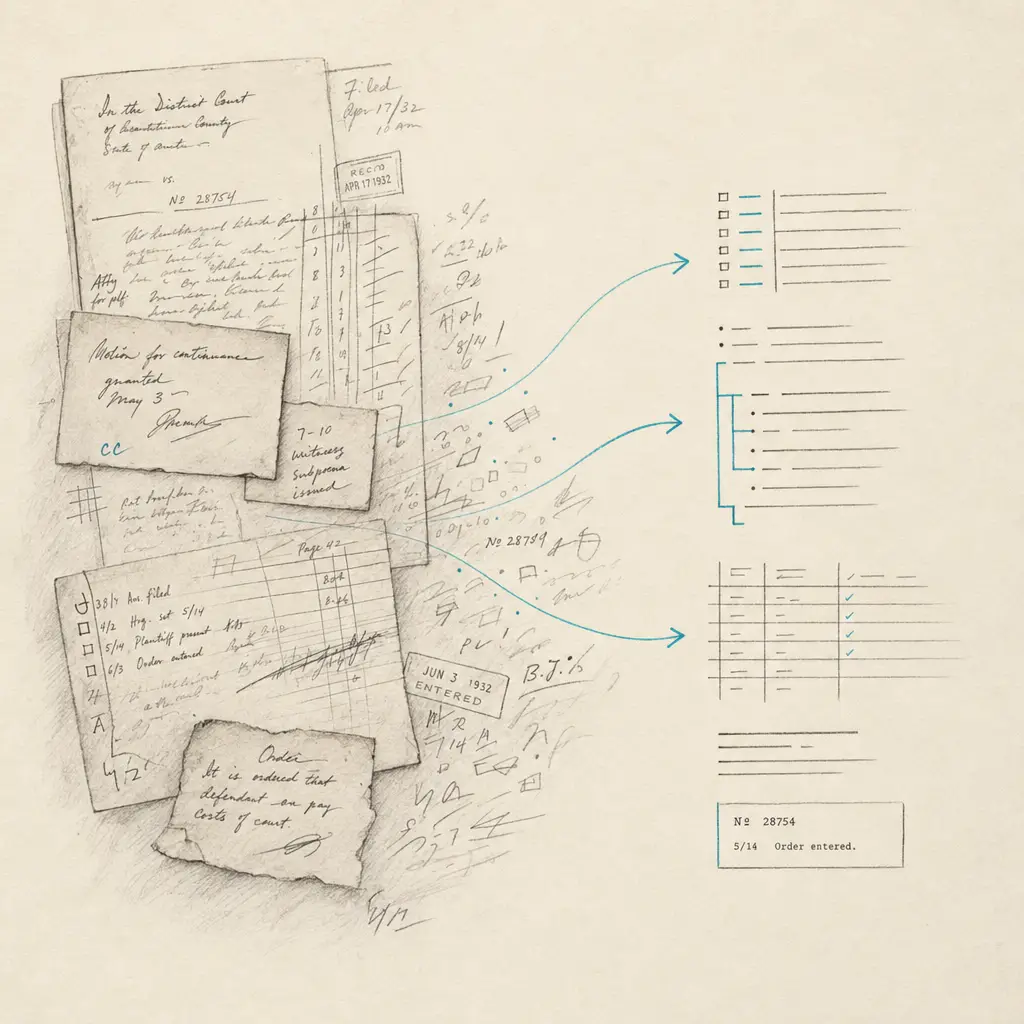
Handwriting OCR converts these handwritten court records into searchable digital text. Legal researchers, attorneys, and court staff can locate specific entries, search across multiple record books, and access procedural history without manually reviewing every page.
Understanding Court Registry Records
Court registries maintain several types of handwritten records that document the flow of cases through the legal system.
Minute Books and Daily Records
The clerk of each court keeps a book in which is written a chronology of the events occurring each day in the courtroom. These minute books record documents filed, appearances made, and orders issued. Before computerization, all of this information was recorded by hand.
Minute books from courts prior to the 1990s exist entirely in handwritten form. These records document the daily activity of courts over decades of operation. Some jurisdictions maintain handwritten minute books dating back over a century, providing a continuous record of judicial proceedings.
Minute books are a daily, handwritten record of documents filed and actions taken with regard to every matter brought before the court.
Docket Sheets and Case Registers
Docket sheets list the date and caption of each paper filed or occurrence in an action. The clerk or court official typically makes a short docket entry describing each item. These entries create a running log of case activity that attorneys and judges reference throughout proceedings.
Historical docket entries often include handwritten annotations, corrections, and notes that don’t appear in formal filings. These annotations may record scheduling changes, informal agreements between parties, or observations about case status that provide context for understanding how matters progressed.
Clerk Annotations on Filed Documents
Court clerks annotate documents as they process them. Filing stamps, date notations, case number assignments, and routing instructions often appear in handwritten form on the margins of filed papers. These annotations establish the official record of when documents were received and how they were processed.
When documents are contested or filing dates become relevant in litigation, these handwritten annotations may be the only evidence of what occurred. Converting them to searchable text preserves this information in accessible form.
Why These Records Matter for Legal Practice
Court registry records serve multiple purposes in legal practice, from routine case management to complex litigation.
Case Research and Preparation
Understanding the procedural history of a matter requires reviewing registry records. What motions were filed? When were hearings held? What orders were entered? The docket provides a complete history of each case in the form of brief chronological entries summarizing court proceedings.
For cases with extensive procedural histories, searching digitized registry records is dramatically faster than reviewing physical minute books. You can locate specific types of entries, find all references to particular parties, or track the sequence of events leading to a particular ruling.
| Registry Record Type | Information Captured | Research Application |
|---|---|---|
| Minute books | Daily court proceedings | Procedural history reconstruction |
| Docket sheets | Document filings and actions | Case timeline development |
| Clerk annotations | Processing details and dates | Filing verification |
| Registry indices | Case organization and cross-references | Locating related matters |
Appeals and Post-Judgment Proceedings
Appellate work often requires detailed understanding of what happened at the trial court level. Registry records document the sequence of events that may not appear clearly in the formal record on appeal. Handwritten minute entries may capture sidebar discussions, scheduling matters, or procedural rulings that become relevant when challenging trial court decisions.
Digital records make it easier for attorneys and judges to access case materials instantly to present them during court proceedings.
When appellate courts need to understand what happened below, searchable registry records allow attorneys to quickly locate and cite relevant procedural history.
Historical and Genealogical Research
Court registry records also serve researchers beyond practicing attorneys. Historic court records have exceptional evidential, informational, and intrinsic value. Genealogists, historians, and journalists access court registries to understand past events, trace family histories, and research historical legal matters.
The National Archives estimates there are more than 2.2 billion textual pages of court materials in federal holdings alone. State and local court records add substantially to this volume. Much of this material, particularly from earlier eras, exists only in handwritten form.
How OCR Processes Registry Records
Converting handwritten registry records to searchable text involves systematic image capture and text extraction.
Image Capture Approaches
Registry records come in various formats that require different capture methods. Bound minute books may need careful photographing or specialized book scanning to capture text near the binding. Loose docket sheets can be fed through document scanners. Annotated filings may need individual page scanning to capture both printed and handwritten content.
The goal is creating clear, high-resolution images where handwritten text is visible. Good lighting, proper alignment, and consistent image quality improve OCR accuracy significantly.
Processing Handwritten Text
Once captured, handwriting OCR technology processes each image to extract text. The system recognizes handwritten words and converts them to searchable digital text. This happens automatically without manual transcription.
Registry records present specific challenges. Historical handwriting styles, abbreviations common in legal practice, and varying ink conditions affect recognition accuracy. However, even partial conversion provides searchable text that helps locate pages containing specific information.
Integration With Legal Research Systems
After conversion, the searchable text integrates into document management systems. You can store converted records alongside case files, create searchable archives of historical minute books, or link registry entries to specific matters in practice management software.
Many legal organizations maintain both the original scanned images and the extracted text. The images preserve the visual appearance of records for evidence purposes. The text enables searching and indexing that the images alone cannot provide.
Practical Benefits for Legal Work
Searchable registry records improve several aspects of legal practice and research.
Faster Case Investigation
When investigating the history of a matter, searchable records eliminate manual page-by-page review. Search for party names, case numbers, or specific terms to locate relevant entries across years of records. What might take hours of physical review becomes a search taking seconds.
This speed matters particularly in litigation discovery where understanding procedural history may be time-sensitive. Deadlines don’t accommodate lengthy manual searches through courthouse archives.
Verification and Authentication
Registry records often serve verification purposes. When did a document actually get filed? What was the sequence of events leading to a particular order? Searchable records allow you to quickly locate and cite specific entries that establish these facts.
For disputes about filing dates, procedural compliance, or sequence of events, easy access to registry records strengthens your ability to prove what actually happened.
Institutional Knowledge Preservation
Court registries accumulate decades of institutional knowledge in their handwritten records. When long-serving clerks retire, their familiarity with historical records often leaves with them. Digitized, searchable records preserve this knowledge base and make it accessible to successors.
This preservation matters for court administration as well as external users. Clerks can serve researchers and attorneys more efficiently when historical records are searchable rather than requiring manual location.
Privacy and Security Considerations
Court records often contain sensitive information requiring appropriate protections.
Confidentiality During Processing
Your court records remain confidential during OCR processing. Files are processed only to deliver your converted text and are not used to train AI models or shared with anyone. The registry entries, case details, and party information in your records stay protected.
This confidentiality applies regardless of content. Records involving sealed matters, sensitive cases, or confidential proceedings all receive the same private treatment during conversion.
Access Control After Conversion
After processing, you control the digital files entirely. Apply your existing security protocols, restrict access according to your organization’s policies, and store files in secure systems appropriate for legal records.
The original physical records remain in their existing locations. Digital conversion creates searchable copies without removing or altering the originals. Physical records maintain their status as official court documents while digital versions enable research and access.
Making Court Records Accessible
Handwritten court registry records document decades of legal proceedings, but that documentation becomes difficult to use when searching requires manual review of physical minute books and docket sheets. Converting legal handwriting to searchable text transforms how you access this procedural history.
The technology handles varied handwriting styles and document conditions typical of court records. Historical entries, clerk annotations, and registry notes all become searchable. Your confidential records remain private throughout processing.
The result is accessible court documentation that serves legal research, case preparation, and historical inquiry. Information that existed only in courthouse archives becomes findable from wherever you work.
Try Handwriting OCR with free credits to see how your registry records convert to searchable text. Your documents remain private, and your court research becomes dramatically more efficient.
Frequently asked questions
Can OCR process old minute books with historical handwriting styles?
Yes, handwriting OCR can process minute books with historical handwriting styles, including cursive writing common in earlier decades. Accuracy varies depending on handwriting legibility and document condition, but even partial recognition provides searchable text that helps locate relevant entries. Very old or deteriorated records may produce less complete conversion, but the resulting text is typically more useful than unsearchable images alone.
How do courts typically use digitized registry records?
Courts use digitized registry records to improve public access and internal efficiency. Searchable archives allow clerks to respond to record requests faster. Staff can locate historical cases without pulling physical files. Some courts integrate digitized records into case management systems, linking historical minute entries to current electronic case files. The searchable text also supports appeals research and helps attorneys verify procedural history.
Are digitized court records admissible as evidence?
Digitized copies of court records generally serve research and reference purposes. For evidentiary purposes, courts typically require certified copies from the clerk's office. However, digitized records help you locate the specific entries you need, which you can then obtain in certified form if required for court submission. The searchable text points you to relevant records that can be officially certified for evidentiary use.
What happens to confidential information in registry records during processing?
Confidential information in registry records remains protected during OCR processing. Files are processed only to extract searchable text and are not retained, analyzed, or shared afterward. If your records contain sealed matters or sensitive case information, you should ensure your own handling procedures comply with applicable confidentiality requirements. The OCR process itself maintains privacy, but you remain responsible for appropriate handling of the resulting digital files.
Can I process registry records from multiple jurisdictions together?
Yes, you can process registry records from different courts and jurisdictions in the same batch. The OCR system processes each document individually regardless of source. However, you may want to maintain organizational structure in your file naming or storage to distinguish records from different courts. After conversion, you can search across all records or filter by jurisdiction depending on your research needs.