
Quick Takeaways
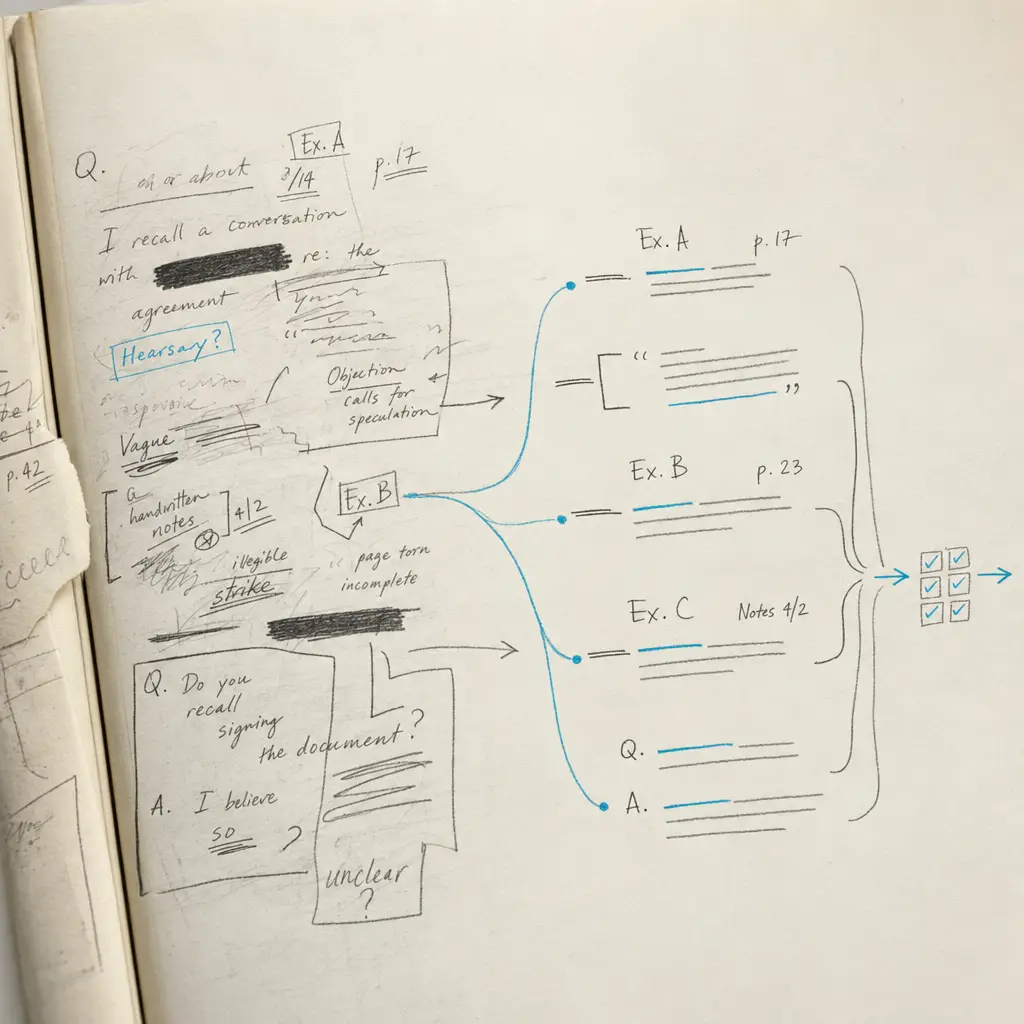
- Handwriting OCR processes handwritten annotations, marginalia, and notes commonly found in litigation materials
- Designed to handle mixed documents where printed exhibits contain handwritten reviewer notes or court annotations
- Makes discovery materials searchable, reducing time spent manually reviewing annotated documents
- Works with scanned discovery productions, depositions with handwritten notes, and annotated exhibits
- Manual review remains essential for context and accuracy verification in litigation contexts
Litigation generates massive volumes of documents. Many arrive with handwritten annotations that contain critical information about case strategy, witness credibility, or document importance. Discovery materials come marked with handwritten notes from opposing counsel. Trial teams annotate exhibits during preparation. Witnesses add handwritten corrections to deposition transcripts.
These handwritten additions create a search problem. You can electronically search the printed portions of discovery materials, but the handwritten marginalia remains locked as images. When a critical note exists somewhere in thousands of pages of annotated documents, finding it means manual page-by-page review. During discovery deadlines or trial preparation, this inefficiency compounds.
This page explains how handwriting OCR applies to litigation and discovery work specifically. It’s not about abstract capabilities. It’s about whether this technology addresses real bottlenecks in document review, what kinds of handwritten litigation materials it processes effectively, and where it fits in existing discovery workflows.
Why Handwritten Content Persists in Litigation
Despite litigation software and document management systems, handwritten annotations remain embedded in discovery and trial preparation workflows. Understanding why helps clarify whether handwriting OCR is relevant to your practice.
Discovery Materials Arrive Annotated
Documents produced during discovery frequently contain handwritten notes added by their creators. Business records include handwritten amendments to contracts. Medical charts contain handwritten physician entries. Financial records show handwritten calculations or corrections. These annotations weren’t added for litigation purposes, but they become part of the evidentiary record.
Review teams add their own handwritten notes during document analysis. Attorneys mark key documents with observations about relevance or privilege. Paralegals annotate exhibits with cross-references to other materials. Consultants add technical notes explaining complex exhibits. These internal annotations capture important insights that inform case strategy.
Court Processes Generate Handwritten Material
Court annotations appear throughout litigation. Judges make handwritten notes on pleadings during hearings. Court clerks add handwritten entries to case files. Opposing counsel annotates exhibits during depositions or trial. These handwritten additions become part of the formal record and may contain critical information about rulings, objections, or judicial observations.
Witness interactions produce handwritten content. Deposition witnesses make handwritten corrections to transcripts. Expert witnesses annotate their own reports with clarifications. Trial witnesses review exhibits and add handwritten notes during preparation sessions. This handwritten material supplements the formal record and may contain admissions or clarifications relevant to case outcomes.
Internal Litigation Work Remains Partially Manual
Trial preparation involves extensive handwritten note-taking. Attorneys annotate witness outlines with observations from interviews. Trial teams mark exhibits with presentation notes and cross-references. Strategy meetings generate handwritten decision trees and case analysis notes. These internal materials aren’t filed with courts, but they represent substantial work product that needs to be accessible to legal teams.
Common sources of handwritten content in litigation:
- Discovery annotations: Handwritten notes added by review teams marking documents as key, privileged, or responsive to specific requests
- Annotated exhibits: Trial exhibits marked with presentation notes, cross-references to testimony, or highlighting of critical passages
- Court annotations: Handwritten entries by judges, court clerks, or opposing counsel on filed documents, orders, or transcripts
- Witness notes: Handwritten corrections to deposition transcripts, annotations on expert reports, or notes from witness preparation sessions
- Internal case materials: Strategy notes, witness interview summaries, legal research annotations, and trial preparation outlines created by hand
- Business records with amendments: Contracts with handwritten changes, financial documents with manual calculations, or correspondence with handwritten additions
The Discovery Search Problem
Modern litigation depends on electronic searchability. When discovery productions contain hundreds of thousands of pages, attorneys use keyword searches, concept searches, and advanced analytics to identify relevant documents. This approach works well for typed content but fails completely when critical information exists in handwritten form.
Handwritten Marginalia Is Invisible to Search
A discovery document might be perfectly searchable as a PDF, but if a reviewer wrote “key document - shows awareness of defect” in the margin, that observation won’t appear in any keyword search. The printed text is indexed, but the handwritten annotation remains a visual element only.
This creates risk. During document production, you might miss documents that contain handwritten notes indicating privilege. During trial preparation, you might overlook exhibits where handwritten annotations explain technical details or connect evidence across multiple documents. When opposing counsel’s handwritten marginalia reveals their litigation strategy, you won’t find it unless you manually review every annotated page.
Legal teams report spending substantial time manually reviewing annotated documents precisely because the handwritten portions can’t be searched. During time-sensitive discovery responses or trial preparation under deadlines, this manual review creates bottlenecks.
Mixed Content Compounds the Challenge
Litigation materials frequently contain both printed and handwritten content on the same page. A business email might have a handwritten routing note at the top. A contract includes typed clauses with handwritten amendments in margins. A medical record combines printed forms with handwritten physician entries.
Standard OCR tools process the printed portions but ignore or misread the handwritten additions. This means you get partial searchability, which can be worse than no searchability at all. You might find a document through keyword search based on the printed text, but remain unaware of contradictory information in handwritten notes on the same page.
Volume Makes Manual Review Impractical
In large litigation matters, discovery productions can include millions of pages. Even after filtering to relevant document sets, review teams still face thousands of pages requiring human analysis. When a significant portion of those pages contain handwritten annotations, the time required for thorough manual review becomes prohibitive.
Associates and paralegals describe scrolling through endless annotated documents looking for specific handwritten notes about dates, names, or case-critical facts. This is time-intensive work that generates billable hours without delivering proportional value to clients. Technology that makes handwritten content searchable fundamentally changes this calculus.
What Handwriting OCR Handles in Litigation Contexts
Handwriting recognition designed for variable handwriting addresses the specific document types and annotation styles common in litigation. Understanding what it processes effectively helps determine whether it’s relevant to your discovery workflow.
Discovery Document Annotations
Review teams mark discovery materials with handwritten observations. These annotations might be rushed notes written during rapid document review, or they might be more deliberate marginalia added during detailed analysis. Handwriting quality varies substantially based on who wrote the note and under what time pressure.
Handwriting OCR processes these annotations by recognizing handwriting patterns across different styles and legibility levels. It handles notes written in margins where space is limited. It adapts to variations in pen type, from ballpoint to felt-tip to pencil. It recognizes both print and cursive writing styles that different reviewers use.
This means annotations like “attorney-client privilege,” “key exhibit for motion,” or “contradicts deposition at p.47” become searchable text rather than image-locked observations. Discovery teams can search for all documents where reviewers noted privilege concerns, or locate exhibits flagged as key to specific legal arguments.
Annotated Exhibits and Trial Materials
Trial exhibits often accumulate handwritten annotations during preparation. Attorneys mark passages to emphasize during examination. Trial consultants add notes explaining technical details. Cross-references connect exhibits to testimony or other evidence. These annotations represent important work product that informs trial strategy.
The technology processes these trial annotations while preserving the connection between handwritten notes and the underlying exhibit. This matters because understanding what was annotated and where provides context. Finding a note that says “impeachment material” is useful. Knowing it appears on a specific email next to a particular statement is actionable.
Litigation teams report that making trial annotations searchable significantly reduces preparation time. Instead of manually reviewing marked exhibits to find specific notes or cross-references, they can search directly for relevant annotations and locate them instantly within hundreds of marked documents.
Court and Witness Annotations
Handwritten entries made by judges, court personnel, or witnesses during litigation proceedings become part of the official record. A judge’s handwritten notes on a motion might indicate preliminary views on legal arguments. Court clerk annotations document filing dates or procedural actions. Witness corrections to deposition transcripts can create admissions or impeachment opportunities.
Handwriting OCR makes these official handwritten annotations searchable and analyzable. Legal teams can locate all instances where a particular judge made handwritten notes on pleadings in similar cases. Appellate attorneys can search court file annotations to understand procedural history. Trial teams can quickly find all handwritten corrections a witness made to their deposition testimony.
Mixed Printed and Handwritten Discovery
Many litigation documents combine printed text with handwritten additions. Business records include typed content with handwritten amendments. Forms contain printed questions with handwritten answers. Correspondence includes typed letters with handwritten postscripts or routing notes.
The system processes both content types on the same page. It recognizes where printed text ends and handwriting begins. It maintains document structure so you can see which portions were original and which were handwritten additions. This is particularly valuable in litigation where proving when and by whom additions were made affects evidentiary value.
Legal professionals working with challenging mixed-content documents describe accurate recognition of both printed and handwritten portions. This dual capability means discovery materials don’t need special handling based on whether they’re purely printed, purely handwritten, or mixed content.
Realistic Expectations for Litigation Use
Understanding what handwriting OCR accomplishes in litigation contexts, and what still requires human judgment, helps set appropriate expectations. This technology accelerates specific workflows without replacing professional review.
The table below shows typical performance across common litigation document types:
| Litigation Material | What Works Well | What Requires Review |
|---|---|---|
| Discovery review notes | Marginalia, document flags, privilege annotations | Personal shorthand, case-specific abbreviations |
| Annotated exhibits | Trial preparation notes, cross-references, emphasis marks | Context-dependent symbols, informal notation systems |
| Court file annotations | Judicial notes on pleadings, clerk entries, procedural marks | Heavily abbreviated legal terms, jurisdiction-specific conventions |
| Witness materials | Deposition corrections, expert report annotations, witness notes | Individual handwriting that’s extremely stylized or rushed |
| Business records with handwriting | Contract amendments, financial calculations, routing notes | Technical industry abbreviations, very small margin notes |
What It Accomplishes
Handwriting OCR converts handwritten litigation annotations into searchable, analyzable text. This means you can keyword search across discovery materials to find documents where reviewers noted specific issues, concerns, or relevance markers. You can locate trial exhibit annotations that reference particular testimony or case facts. You can search court file materials for judicial observations across multiple cases.
The technology processes scanned discovery productions without requiring format conversions or special preparation. Upload annotated PDFs from discovery, and the system processes both printed content and handwritten additions. No preprocessing, no special handling, no technical configuration.
Document structure is preserved where possible. This matters in litigation because understanding where an annotation appears relative to the underlying document content affects interpretation. A note at the top of a contract has different implications than a note next to a specific clause.
What Still Needs Professional Review
Legal terminology and case-specific abbreviations require verification. If a reviewer wrote “SOL issue” in a margin, the system might recognize the text accurately but cannot infer whether “SOL” means statute of limitations, standard of living, or something else specific to the case. Legal professionals familiar with the matter provide this contextual interpretation.
Personal annotation systems and symbols need human understanding. Trial teams often develop their own shorthand or marking systems. A check mark might mean “confirmed by witness” in one case and “disputed fact” in another. Technology recognizes the mark. Legal teams interpret its meaning.
Extremely rushed or degraded handwriting presents challenges. Notes written during fast-paced court proceedings might be less legible than annotations made during deliberate document review. Very old discovery materials might have degraded scan quality. These materials still benefit from processing, but output requires more careful verification.
The goal is not to eliminate human review in litigation. The goal is to transform unsearchable handwritten annotations into searchable text that legal teams can efficiently locate, analyze, and verify using their professional expertise.
Where This Fits in Discovery Workflows
Handwriting OCR addresses specific friction points in litigation document review. It’s not a replacement for legal analysis or privilege review. It’s a tool for making handwritten litigation materials accessible to the same search and analysis capabilities used for typed content.
How litigation teams use handwriting OCR:
-
Discovery review efficiency: Converting handwritten reviewer annotations to searchable text allows quality control teams to quickly locate documents flagged for specific issues, privilege concerns, or production decisions. Rather than manually reviewing thousands of annotated pages, supervisors can search for annotations mentioning privilege, responsiveness, or key case facts. Learn more about processing handwritten discovery annotations.
-
Trial preparation acceleration: Making handwritten trial exhibit annotations searchable enables trial teams to rapidly locate cross-references, impeachment notes, or technical explanations across hundreds of marked exhibits. When preparing witness examination, attorneys can search exhibit annotations for references to specific testimony or documents rather than manually reviewing every marked page. Understand how this works for handwritten annotated exhibits.
-
Court record analysis: Processing handwritten judicial notes and court clerk annotations makes procedural history searchable and analyzable. Appellate attorneys researching how particular judges rule on motions can search court file annotations rather than manually reviewing physical files. This capability extends to handwritten court annotations across multiple cases.
-
Witness material review: Digitizing handwritten witness corrections to depositions and expert report annotations enables trial teams to quickly locate all changes or clarifications a witness made. During cross-examination preparation, attorneys can search for patterns in how witnesses corrected their testimony or modified their opinions. See how this applies to handwritten witness notes.
-
Strategic document analysis: Making business records with handwritten amendments searchable allows litigation teams to find all contracts where specific types of changes were made by hand, or locate financial documents with particular handwritten calculations. This pattern analysis is impractical when handwritten content remains image-locked.
The consistent theme across these applications is efficiency improvement. Technology handles the mechanical work of making handwriting searchable. Legal professionals apply their expertise to searching strategically, interpreting results in context, and making the case judgments that require legal training.
Privacy and Confidentiality in Litigation Contexts
Litigation materials are confidential. Discovery documents contain sensitive business information. Work product annotations reveal case strategy. Witness materials may include protected communications. Any technology that processes these materials must maintain confidentiality as a baseline requirement, not an optional feature.
How Document Privacy Works
When you process litigation materials through handwriting OCR, documents are handled only for the purpose of delivering results to you. They are not used to train AI models. They are not retained longer than necessary to complete processing. They are not shared with third parties or made accessible to other users.
This matters particularly in litigation because discovery materials are often protected by confidentiality orders. Work product annotations are privileged. Court documents may be filed under seal. The tool is designed to maintain these protections throughout processing.
Compliance with Professional Obligations
Legal professionals have ethical obligations regarding client confidentiality and work product protection. Using third-party technology services doesn’t eliminate these obligations. The service is structured to support compliance with these professional requirements rather than creating conflicts with them.
Documents remain under your control. You upload materials for processing, receive results, and maintain custody of both the originals and the processed output. The service provider doesn’t claim rights to your documents, doesn’t access them for purposes other than processing, and doesn’t retain them in ways that compromise confidentiality.
Security During Processing
Litigation materials are transmitted and processed using standard security protocols. Documents are encrypted during transmission. Processing occurs in secure environments. Access is limited to systems necessary for completing the OCR operation.
This infrastructure is designed for business-critical documents where security failures create real professional liability and client harm. While no technology eliminates all risk, the architecture prioritizes security in ways that recognize the sensitive nature of legal materials.
Getting Started with Litigation Materials
If you’re dealing with handwritten annotations in discovery or trial preparation and wondering whether this tool addresses your specific bottlenecks, the most direct approach is testing with your actual litigation materials.
Discovery document quality varies substantially. Notes from different reviewers use different handwriting styles. Exhibits annotated under time pressure differ from materials marked during deliberate trial preparation. The only way to know if handwriting OCR will improve your specific workflow is to try it with the kinds of annotated documents you actually encounter.
HandwritingOCR offers a free trial with credits for processing sample documents. Upload an annotated discovery document, a page of trial exhibit notes, or court materials with handwritten entries. See how the output compares to what you’d achieve through manual transcription or other approaches you’ve tried.
Your litigation materials remain confidential throughout this process. Test documents are processed only to deliver results to you and are not used for any other purpose. This is designed for legal professionals who cannot compromise client confidentiality to test software.
The service is straightforward to use. Upload scanned discovery materials or annotated exhibits, process them, and download searchable text output. There’s no complex setup, no software installation, and no commitment required to determine whether it works for your documents.
If it reduces the time you spend manually reviewing annotated discovery or locating specific trial exhibit notes, it likely will deliver similar benefits on comparable materials. If accuracy doesn’t meet your requirements for litigation use, you’ve learned that before investing further. Either way, you’ll understand more clearly whether handwriting OCR addresses real bottlenecks in your discovery and trial preparation workflows.
For broader context on how handwriting OCR applies across legal practice, see our guide to handwriting OCR for legal professionals.
Frequently asked questions
Can handwriting OCR process discovery materials that contain both printed documents and handwritten annotations?
Yes, handwriting OCR is specifically designed to handle mixed content where printed documents contain handwritten reviewer notes, marginalia, or annotations. This is extremely common in discovery materials where typed business records arrive with handwritten entries, or where review teams add handwritten notes to printed exhibits. The system processes both the printed text and handwritten additions, making the entire document searchable while preserving the structure so you can see which portions were original and which were annotated.
How does handwriting OCR help with discovery review when dealing with thousands of annotated pages?
By converting handwritten reviewer annotations into searchable text, legal teams can use keyword searches to locate specific types of annotations across large discovery sets. Instead of manually reviewing thousands of pages to find documents where reviewers noted privilege issues, marked materials as key exhibits, or flagged responsiveness concerns, you can search for those annotation terms directly. This substantially reduces the time quality control teams spend reviewing annotated discovery materials and helps ensure important reviewer notes aren't overlooked.
Are litigation documents kept confidential when processed through handwriting OCR?
Yes, litigation materials are processed only to deliver results to you and are not used to train AI models, shared with third parties, or retained longer than necessary to complete processing. This is designed specifically for legal professionals who have ethical obligations regarding client confidentiality and work product protection. Documents remain under your control throughout processing, with security protocols appropriate for sensitive legal materials.
Can handwriting OCR recognize the different annotation styles used by multiple review team members?
Yes, the technology is built to handle variable handwriting quality and different writing styles. Discovery review teams typically include multiple attorneys and paralegals, each with different handwriting characteristics. The system adapts to these variations, processing both neat deliberate annotations and rushed notes written during rapid document review. While extremely stylized or heavily abbreviated personal shorthand may require more review, standard handwritten legal annotations from multiple team members are processed effectively.
What file formats work for processing annotated discovery materials?
Handwriting OCR processes scanned PDFs and common image formats including JPG, PNG, and TIFF. Most discovery productions arrive as PDFs, which can be uploaded directly without conversion. The output is delivered as searchable text in formats like Word (DOCX), plain text, or Markdown depending on your workflow needs. There's no special preparation required for discovery materials, you work with the scanned documents you already have.