
Quick Takeaways
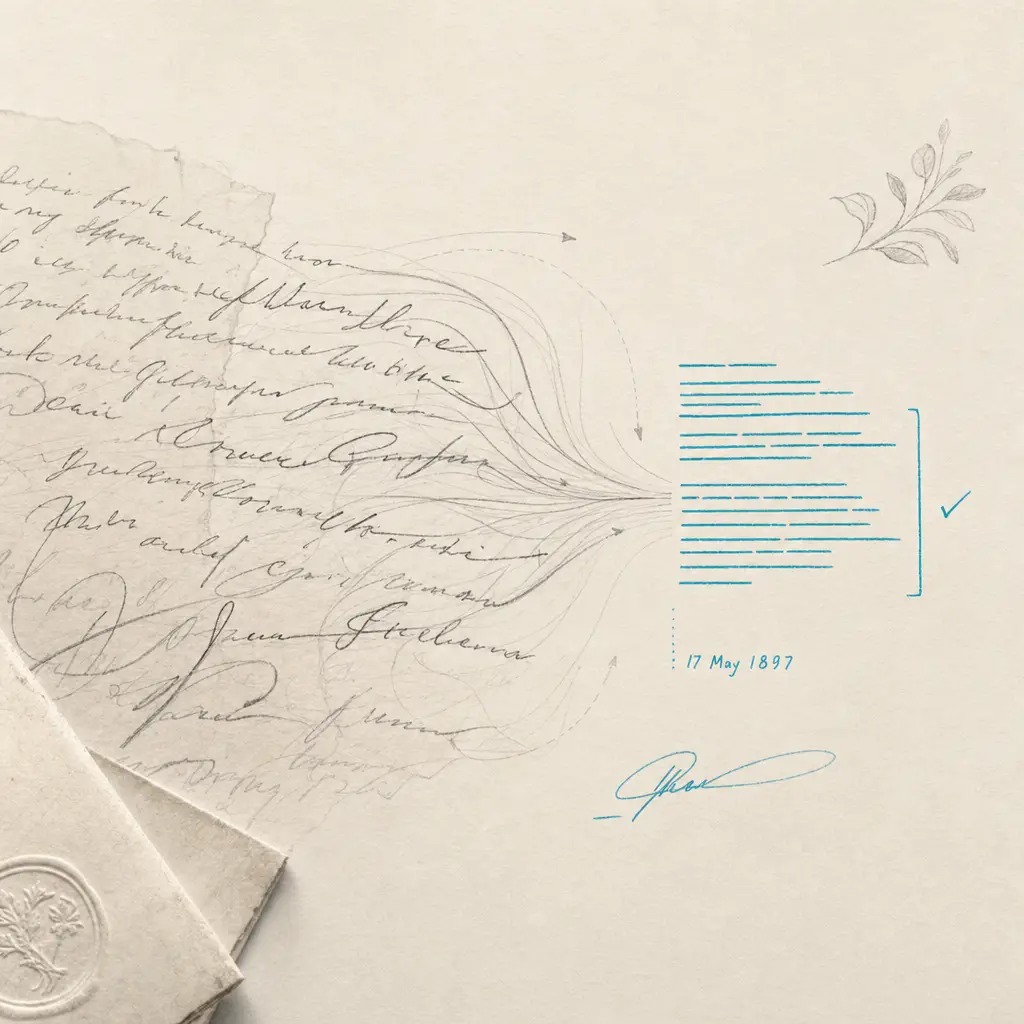
- Handwriting OCR converts holographic wills to searchable, editable text for faster legal review and authentication processes
- Processes entirely handwritten testamentary documents including informal language, amendments, and codicils
- Makes testamentary provisions searchable across documents without reading entire wills repeatedly
- Handles historical handwriting styles and documents that may be decades old
- Legal interpretation, validity determination, and handwriting authentication still require professional expertise
Holographic wills arrive in probate practice as entirely handwritten testamentary documents. Unlike attorney-drafted wills with standardized language and formal structure, these documents reflect how testators actually write when creating wills without legal guidance. They use informal phrasing, unclear terminology, and personal references that require interpretation. The handwriting quality varies dramatically depending on the testator’s age, health, and writing habits when the document was created.
This creates immediate practical challenges. You can’t search a handwritten will for specific beneficiaries or provisions without reading the entire document. Sharing wills with handwriting experts during authentication means providing static scans that remain locked in their original form. Extracting provisions to quote in probate petitions requires manual transcription. When wills include handwritten amendments, cross-outs, or marginal notes, understanding the testator’s final intentions becomes even more complex.
This page explains what handwriting OCR can and cannot do specifically for holographic wills and handwritten testamentary documents. It’s not about eliminating legal review or replacing professional judgment. It’s about understanding whether this tool can accelerate specific workflows in probate practice and where realistic expectations lie.
For broader context on handwriting OCR in probate work, see Probate, Wills & Estate Handwriting OCR.
Why Holographic Wills Present Unique Challenges
Handwritten wills differ fundamentally from typed testamentary documents. They’re created without legal guidance, they use informal language that requires interpretation, and they present authentication challenges that typed wills avoid entirely.
Written Without Legal Formality
When testators create holographic wills, they write in their own words without attorney assistance. This produces testamentary language that may be legally ambiguous. A provision stating “divide my things fairly among my children” is entirely handwritten and appears to express clear intent, but what “fairly” means requires legal interpretation and may need court determination.
Informal references create similar challenges. When a will mentions “the house” without specifying which property, or “whatever remains after taking care of Mom” without defining the care arrangement, attorneys must interpret these provisions based on context, extrinsic evidence, and applicable law. The fact that the language is handwritten doesn’t make the interpretation automatic.
This informality extends to document structure. Holographic wills may lack standard provisions found in attorney-drafted documents. They might not include executor appointments, residuary clauses, or formal attestation. Understanding what the testator intended requires reading the entire document and considering what’s implied even when it’s not explicitly stated.
Authentication Requires Handwriting Analysis
Probate courts must verify that holographic wills are genuinely written by the testator. This authentication process involves comparing the will’s handwriting to known exemplars of the testator’s writing. Handwriting experts may be engaged to provide opinions on authorship. Witnesses might testify about their familiarity with the testator’s handwriting.
This authentication work requires access to the handwritten document in forms that facilitate comparison and analysis. Sharing static scans works, but being able to provide searchable text versions alongside the original images can accelerate expert review and make comparison processes more efficient.
When authentication is contested, having multiple formats available—original scans for visual comparison and searchable text for content analysis—provides flexibility during the authentication process.
Amendments and Modifications Complicate Interpretation
Testators may amend holographic wills by crossing out provisions, writing between lines, or adding notes in margins. Each handwritten change creates questions about timing, intent, and legal effect. Were all modifications made at the same time? Did the testator intend the cross-out to revoke the provision entirely or was it a draft notation? Are marginal additions part of the executed will or just contemplated changes?
These questions require legal analysis that goes beyond text extraction. But having searchable versions of the will including handwritten amendments allows faster identification of all modifications, easier comparison of original and amended provisions, and more efficient preparation of authentication arguments for court.
Variable Handwriting Quality Affects Processing
Holographic wills may be written by elderly testators, individuals with health conditions affecting fine motor control, or people writing under emotional stress. This produces handwriting quality that ranges from careful penmanship to barely legible scrawl.
Some holographic wills are written over multiple sessions as testators contemplate their intentions. This can result in variable handwriting quality within the same document as the testator’s physical condition or writing materials change between sessions.
Historical wills add another layer of variability. Testamentary documents from decades ago use cursive styles that were standard then but less common now. Older paper may have degraded, ink may have faded, and storage conditions may have affected document preservation.
What Handwriting OCR Handles in Holographic Wills
Handwriting recognition designed specifically for variable handwriting approaches holographic wills differently than standard OCR approaches printed text. Rather than expecting consistent formatting and standardized language, it’s trained to process the informal, variable content that characterizes actual testamentary documents.
Full Text Extraction from Handwritten Documents
Handwriting OCR converts entirely handwritten wills to editable, searchable text. This means you can search for specific beneficiary names, asset descriptions, or testamentary provisions without reading the entire will repeatedly. When comparing multiple drafts or versions, being able to search across all documents simultaneously saves substantial time.
Text extraction preserves the testator’s actual language. If a will states “I leave my fishing equipment to whoever will use it properly,” the OCR extracts that exact phrasing. It doesn’t attempt to formalize informal language or impose standard testamentary terminology. This is appropriate because the testator’s actual words matter for legal interpretation.
Searchability changes how attorneys work with holographic wills. Instead of manually locating every mention of a specific beneficiary across multiple pages, you can search digitally. When preparing probate petitions that need to quote specific provisions, you can extract text rather than manually transcribing. When sharing wills with co-counsel or handwriting experts, you can provide both original scans and searchable text versions.
Document Structure Preservation
Holographic wills may have internal structure even if they lack formal legal organization. Testators might organize bequests by category, group family members together, or use spacing and indentation to show relationships between provisions. This visual structure can affect interpretation when questions arise about the testator’s intent.
Handwriting OCR attempts to preserve this document structure during conversion. Paragraphs remain distinct. Spacing that indicates separate provisions is maintained where possible. List formatting is preserved when testators have used it to organize bequests.
This structural preservation matters for legal review. Understanding which provisions the testator grouped together, what was emphasized through spacing or layout, and how the document was organized provides context that flat transcription loses.
Handwritten Amendments and Modifications
When holographic wills include handwritten cross-outs, interlineations, or marginal additions, the OCR processes these modifications as they appear in the document. Struck-through text may be captured along with replacement language. Marginal notes are extracted as additional content. Insertions written between lines are recognized as separate elements.
This doesn’t resolve legal questions about the validity or timing of amendments. That requires professional legal analysis. But having searchable versions of both original and modified text allows faster identification of all changes and more efficient preparation of arguments about testamentary intent and document validity.
Historical Handwriting and Cursive Writing
Probate practice involves testamentary documents that may be decades old. Wills written in the 1970s, 1980s, or earlier use cursive styles that were standard educational practice then but less common now. Older documents may have formal penmanship with flourishes and embellishments.
Handwriting OCR is designed to process these historical styles. It handles cursive writing where letters flow together continuously. It adapts to formal penmanship common in older documents. It works with the handwriting styles that appear in actual probate records rather than only contemporary samples.
This doesn’t mean every historical document will process perfectly. Severely degraded paper, extremely faded ink, or highly ornate handwriting will still present challenges. But the technology is built to handle variation in handwriting styles across decades of testamentary documents.
What Requires Professional Legal Review
Holographic wills are legal documents where professional judgment is non-negotiable. Handwriting OCR accelerates text extraction, but it cannot replace the legal expertise required to interpret testamentary language, verify authenticity, or determine validity under applicable law.
Testamentary language interpretation:
When holographic wills use informal phrasing like “divide things fairly,” “take care of the family,” or “whatever seems right,” the OCR extracts those exact words. Legal professionals must determine what these phrases mean under relevant law and in the specific context of the estate. Technology cannot make these legal determinations.
Ambiguous references require case knowledge to interpret correctly. If a will mentions “the car” when the estate includes multiple vehicles, or “the house” when the testator owned several properties, context beyond the will itself determines which asset was intended. Extracting the text is only the beginning of this interpretive process.
Validity and execution requirements:
Whether a holographic will meets legal requirements for valid execution depends on jurisdiction-specific rules about handwriting, signature, testamentary intent, and execution formalities. Some jurisdictions require the entire will to be in the testator’s handwriting. Others allow printed portions if material provisions are handwritten. Some require witnesses; others accept entirely unwitnessed holographic wills.
These validity questions require legal analysis of applicable law and factual circumstances. OCR cannot determine whether a document satisfies legal requirements for testamentary validity.
Authentication and handwriting verification:
Verifying that a holographic will was actually written by the testator requires handwriting analysis and authentication procedures. This may involve comparing the will to known exemplars of the testator’s writing, engaging handwriting experts, or taking testimony from witnesses familiar with the testator’s handwriting.
While searchable text versions can accelerate expert review and make comparison processes more efficient, authentication itself remains a professional task requiring expertise in handwriting analysis or testimony about the testator’s writing characteristics.
Amendment timing and revocation questions:
When holographic wills include handwritten modifications, determining when changes were made, whether the testator intended them as binding amendments, and whether they effectively revoke earlier provisions requires legal analysis. The same physical act of crossing out text might be a binding revocation in one context and merely a draft notation in another.
Technology can identify that modifications exist and extract both original and amended text. Legal professionals must determine the legal effect of those modifications based on evidence about testamentary intent and applicable law.
Where This Fits in Probate Practice Workflows
Handwriting OCR addresses specific bottlenecks in probate workflows involving holographic wills. It’s not a replacement for legal review or professional judgment. It’s a tool for removing friction from processes that currently require extensive manual transcription and document handling.
How probate attorneys use handwriting OCR for holographic wills:
Authentication preparation: Converting handwritten wills to searchable text allows simultaneous work by multiple team members during authentication. While one attorney reviews the original document, handwriting experts can search through text versions for specific phrases or provisions. Comparison between the will and exemplar documents becomes more efficient when content is searchable rather than requiring manual reading of entirely handwritten materials.
This parallel work accelerates authentication timelines. Tasks that would need to happen sequentially with only handwritten originals can proceed simultaneously when team members have both scanned originals and searchable text versions.
Probate petition preparation: Petitions for probate typically quote testamentary provisions to demonstrate the will’s contents and support arguments about testamentary intent. When working with holographic wills, this requires transcribing relevant provisions from handwritten documents.
Handwriting OCR produces editable text that can be extracted for court filings. Rather than manually transcribing quotes and risking transcription errors, attorneys can copy provisions from searchable text, then verify accuracy against the original document. This speeds petition preparation and reduces the risk of misquoting testamentary language in court documents.
Will contest preparation: When holographic wills are contested, attorneys need to analyze every provision, identify ambiguous language, and locate all references to disputed beneficiaries or assets. Doing this with entirely handwritten documents means reading the complete will multiple times and manually creating indexes of relevant provisions.
Searchable versions allow instant location of every mention of specific beneficiaries, assets, or provisions. When preparing for will contest litigation, being able to search rather than manually read saves substantial attorney time and makes analysis more thorough.
Multi-party review and collaboration: Probate involving contested holographic wills may require coordination between multiple attorneys representing different beneficiaries, handwriting experts, and courts. Each party needs access to the will’s contents for their own review and analysis.
Providing searchable text versions alongside original scans gives all parties efficient access to the will’s contents while preserving the original for visual inspection and handwriting analysis. This facilitates more efficient review by all participants in the probate process.
Historical will research: When researching precedents for unusual testamentary provisions or studying how courts have interpreted similar informal language in past cases, access to historical holographic wills is valuable. But archives of old testamentary documents exist primarily as handwritten originals or scanned images.
Converting these historical wills to searchable text makes precedent research feasible. Rather than reading through decades of handwritten wills looking for relevant language, researchers can search across digitized collections for specific phrases or provisions.
The common thread across these uses is acceleration rather than replacement. Technology handles the mechanical work of converting handwriting to searchable text. Probate professionals apply their expertise to legal interpretation, validity determination, authentication, and the professional judgments that require legal training.
Getting Started with Holographic Will Processing
If you’re handling holographic wills in your probate practice and wondering whether handwriting OCR will improve your authentication and review workflows, the most direct approach is testing with actual testamentary documents.
Handwriting in holographic wills varies dramatically. Wills written by healthy testators with careful penmanship differ from those created by elderly individuals with diminished fine motor control. Historical wills use different cursive styles than contemporary documents. The only way to know if handwriting OCR will accelerate your specific workflows is to try it with the kinds of testamentary documents you actually encounter in practice.
HandwritingOCR offers a free trial with credits you can use to process sample wills. Upload a holographic will from your case files, process it, and compare the output to what you’d get from manual transcription. See whether the searchability and editability provide value for your authentication and probate petition workflows.
Your client documents remain confidential throughout this process. Wills are processed only to deliver results to you and are not used to train AI models or shared with anyone else. This is essential for testamentary documents where attorney-client privilege and client confidentiality are professional obligations.
The service is designed to be straightforward. Upload scanned wills, process them, and download the results as searchable text in Word, Markdown, or other formats compatible with your document management system. There’s no complex setup, no software installation, and no commitment required to test whether it works for your holographic wills.
If it saves time on the sample documents you tested, it will likely provide similar value for other holographic wills in your probate practice. If accuracy doesn’t meet your requirements for specific handwriting styles, you’ll know that before investing further. Either way, you’ll have clearer understanding of where handwriting OCR fits in testamentary document workflows.
Frequently asked questions
Can handwriting OCR determine if a holographic will is valid?
No. Handwriting OCR converts handwritten testamentary documents to searchable text, but it cannot make legal determinations about validity. Whether a holographic will meets requirements for valid execution depends on jurisdiction-specific law, testamentary intent, and factual circumstances that require professional legal analysis. The OCR provides searchable text; attorneys determine validity under applicable law.
Will OCR authenticate handwriting in holographic wills?
No. Handwriting authentication requires expert analysis comparing the will to known exemplars of the testator's writing. However, searchable text versions can accelerate expert review by allowing handwriting experts to search for specific provisions or phrases while conducting their visual analysis of the handwritten original. The OCR facilitates the authentication process but does not replace expert handwriting analysis.
Can handwriting OCR interpret ambiguous testamentary language?
No. The OCR extracts exactly what the testator wrote, preserving informal phrasing like "divide fairly" or "whatever seems right" without attempting to interpret meaning. Legal interpretation of ambiguous testamentary language requires professional expertise considering applicable law, extrinsic evidence, and case context. Technology provides searchable text; attorneys provide legal interpretation.
How does OCR handle handwritten amendments and cross-outs?
Handwriting OCR processes handwritten amendments, interlineations, and cross-outs as they appear in the document, extracting both original and modified text where possible. However, determining the legal effect of these modifications—whether they constitute binding amendments, when they were made, and whether they revoke prior provisions—requires legal analysis. The OCR identifies that modifications exist; attorneys determine their legal effect.
Are holographic wills kept confidential during OCR processing?
Yes. Your testamentary documents remain confidential and are processed only to deliver results to you. They are not used to train AI models, not shared with third parties, and not retained longer than necessary to complete processing. This is essential for estate documents where attorney-client privilege and client confidentiality are professional obligations, not preferences.