
Quick Takeaways
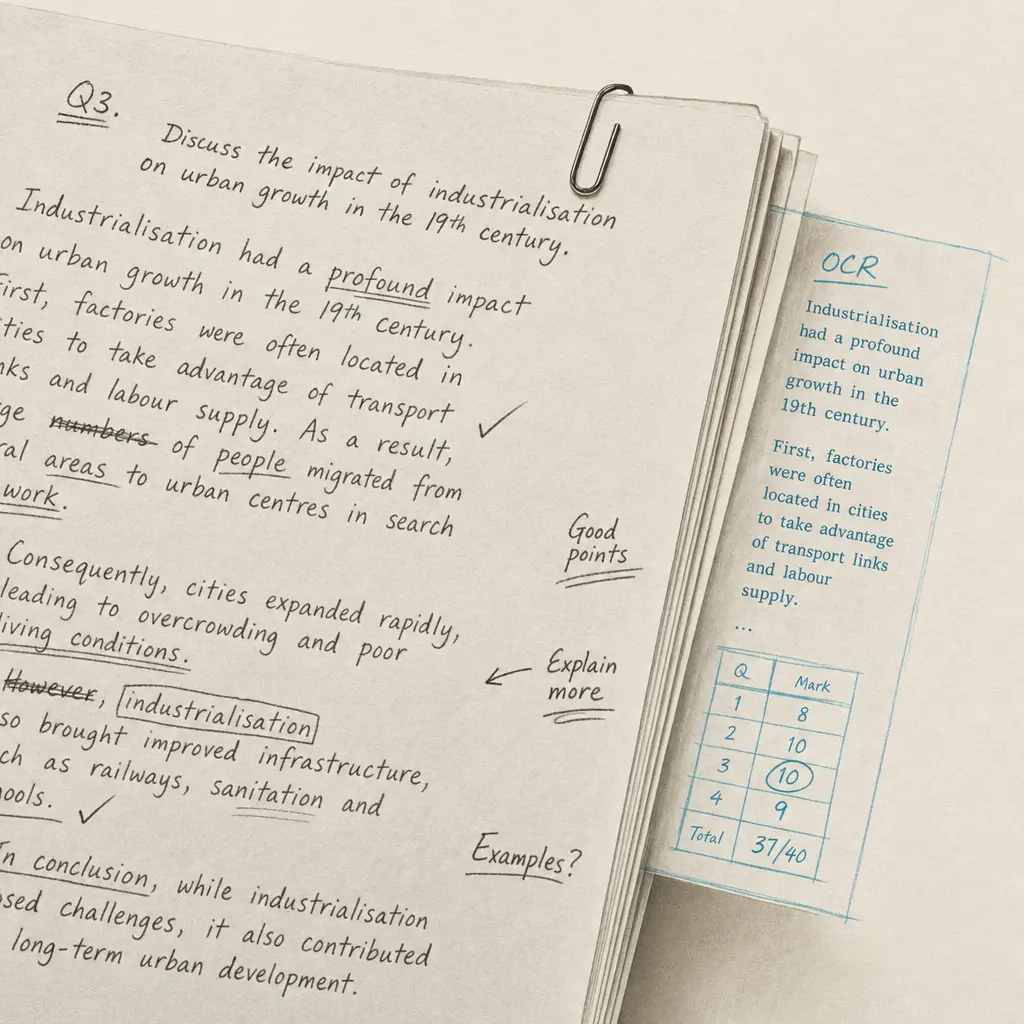
- Handwriting OCR converts handwritten exam answers into searchable, gradable text
- Process essay responses, short answers, problem solutions, and written explanations
- Enables keyword searching across student answers and faster grading workflows
- Critical for educators managing large volumes of handwritten assessments
- Student exam papers remain confidential throughout processing
Handwritten exams remain common in education despite digital alternatives. Students write essay responses, show mathematical work, diagram solutions, and provide written explanations on paper exams. These handwritten answers contain the content educators need to assess, but they exist in a format that cannot be searched, analyzed, or efficiently processed at scale.
When educators face stacks of handwritten exam papers, grading becomes purely manual work. You cannot search student answers for specific concepts or keywords. You cannot easily identify which students addressed particular topics. If you need to review how students answered a specific question across all exams, it means reading through every handwritten paper. After grading, student handwriting remains locked in physical form, making it difficult to analyze patterns or provide detailed feedback.
This page explains how handwriting OCR makes exam papers searchable and supports grading workflows. It addresses what types of handwritten exam content it processes, how educators use it for assessment and feedback, and realistic expectations when working with variable student handwriting under exam conditions.
Why Handwritten Exams Persist in Education
Despite digital assessment tools, handwritten exams remain widely used across educational levels. Understanding why helps clarify whether OCR technology addresses real educational needs.
Essay and Extended Response Assessment
Many disciplines require students to develop extended written responses that demonstrate critical thinking, analysis, and synthesis. Students need time and space to organize thoughts, revise arguments, and present coherent responses. Handwritten essay exams allow this process without requiring students to have equal access to typing technology or adapt to timed digital interfaces.
Educators value seeing student thought processes reflected in handwritten work. Crossed-out text, marginal notes, and revision patterns reveal how students approach problems. These artifacts of thinking are valuable for assessment but remain invisible to analysis when handwriting cannot be processed.
Making handwritten essay responses searchable allows educators to locate specific arguments, identify common themes across student answers, and provide targeted feedback based on actual student language rather than memory of what papers contained.
Students write millions of handwritten exam answers annually, creating assessment content that remains unsearchable until digitized.
Mathematical and Scientific Problem Solving
Mathematics, physics, chemistry, and engineering exams require students to show their work. The process matters as much as the final answer. Students must demonstrate understanding through equations, diagrams, calculations, and written explanations of their reasoning.
These problem solutions are inherently handwritten. Students write equations, draw diagrams, show calculation steps, and explain their approach. While final numerical answers might be gradable by automated systems, the mathematical work and explanations remain handwritten and require human assessment.
Searchable mathematical work enables educators to find all students who used particular solution methods, identify common calculation errors, or locate explanations that demonstrate specific misconceptions. This supports both grading efficiency and pedagogical analysis.
Equitable Assessment Conditions
Not all students have equal access to computers or typing proficiency. Handwritten exams provide equitable assessment conditions where success depends on content knowledge rather than technological access or typing speed.
For students with learning differences, handwritten exams may be more accessible than digital alternatives. Some students think more clearly when writing by hand. Others struggle with timed digital interfaces but perform well with paper and pencil.
Making handwritten exam content digitally searchable preserves equitable assessment conditions while enabling modern grading and analysis workflows. Students write by hand, but educators can process that handwriting using digital tools.
The Grading Challenge with Handwritten Exams
Grading handwritten exams involves reading through student answers, evaluating content, assigning scores, and providing feedback. When exam volumes are large, this manual process creates practical challenges.
Manual Reading at Scale
A single educator might grade 100 or more handwritten exam papers in a semester. Each exam might contain multiple essay questions or extended responses. Reading through all this handwritten content takes substantial time.
The reading process is entirely manual. Educators must read each student’s handwriting, understand their arguments, evaluate content quality, and determine scores. There are no shortcuts when handwriting cannot be processed digitally.
Educators describe spending entire weekends grading handwritten exams. The work is cognitively demanding and physically tiring. Eye strain from reading variable handwriting for hours is common. The volume of reading required affects turnaround time for student feedback.
Inconsistency Across Large Cohorts
When grading hundreds of handwritten answers to the same question, maintaining consistency becomes challenging. The first papers graded might receive different evaluation than later papers as the educator’s standards evolve through the grading process.
Without ability to search across student answers, educators cannot easily verify consistent application of grading criteria. They cannot quickly locate all responses that mentioned specific concepts to ensure comparable treatment. Memory of what earlier students wrote fades as grading progresses.
This consistency challenge affects fairness. Students deserve grades based on consistent standards, but purely manual grading of handwritten work makes consistency difficult to verify or maintain across large cohorts.
Grading 100 handwritten essay exams can require 30-40 hours of continuous reading, creating unsustainable workload for educators.
Limited Feedback Mechanisms
Detailed feedback helps students learn, but providing written comments on handwritten exams is time-consuming. Educators must handwrite feedback or type separate documents. The time required for detailed feedback often means students receive only scores and brief comments.
When exam content is handwritten and unsearchable, educators cannot easily reference specific student language in feedback. They work from memory of what a student wrote or must reread papers while writing comments. This slows feedback preparation and affects detail quality.
Students benefit from specific feedback that quotes their answers and explains strengths or weaknesses. Creating this detailed feedback from handwritten exam papers requires extra time that many educators cannot afford within academic calendars.
What Handwriting OCR Processes in Exam Papers
Handwriting recognition processes the types of content that appear in student exam answers. Understanding what it handles helps determine whether it addresses grading workflow challenges.
Essay Responses and Extended Answers
Students write essay responses ranging from single paragraphs to multi-page answers. These responses include thesis statements, supporting arguments, evidence citations, and conclusions. The handwriting quality varies based on student writing habits, time pressure, and exam stress.
Handwriting OCR processes essay content including complete sentences, paragraph structures, and extended arguments. It handles both neat deliberate handwriting and more rushed writing produced under exam time constraints. It recognizes common academic vocabulary while adapting to individual writing styles.
This means essay content becomes searchable. Educators can locate student responses mentioning specific concepts, find arguments that reference particular evidence, or identify answers that address required elements. What would require rereading every exam becomes a search query.
Short Answer and Explanation Responses
Many exams include short answer questions requiring one to three sentence responses or brief explanations. Students provide definitions, identify concepts, or explain processes in concise handwritten answers.
The technology processes these short responses including technical terminology, concept definitions, and explanatory sentences. It handles the condensed handwriting that students sometimes use when space is limited or time is short.
Searchable short answers enable quick verification that students addressed required topics. Educators can search for key terms to identify complete versus incomplete answers, locate students who misunderstood questions, or find particularly strong explanations to use as examples.
Mathematical Work and Problem Solutions
Problem-based exams include handwritten mathematical equations, calculation steps, and explanatory text about solution methods. Students write variable names, operators, numerical calculations, and descriptions of their approach.
Handwriting OCR processes mathematical notation including equations with variables and operators, numerical calculations showing step-by-step work, and written explanations that accompany mathematical solutions. It recognizes common mathematical symbols while acknowledging that complex notation may require verification.
This enables searching for specific solution approaches, locating students who used particular formulas, or finding explanations of mathematical reasoning. While grading mathematical work still requires evaluating correctness, searchability accelerates finding specific types of student work.
| Exam Content Type | Typical Format | Grading Challenge | Searchability Benefit |
|---|---|---|---|
| Essay responses | Multi-paragraph answers | Reading all papers to assess arguments | Search for specific concepts across all responses |
| Short definitions | Single sentence answers | Verifying key terms included | Quickly identify complete versus incomplete answers |
| Problem solutions | Equations and calculations | Finding specific solution methods | Locate all students using particular approaches |
| Explanatory text | Written reasoning | Assessing understanding depth | Find demonstrations of specific concepts |
| Diagram labels | Handwritten annotations | Reading small text on diagrams | Search for correct terminology |
How Educators Use Exam Paper OCR
Making handwritten exam papers searchable addresses specific bottlenecks in grading and assessment workflows. Educators apply this capability to grading efficiency, consistency verification, and feedback preparation.
Faster Grading Through Search
Educators can search across student answers to identify which responses addressed required elements. Instead of carefully reading every word to determine if a student mentioned specific concepts, they search for key terms and review only relevant portions of answers.
For essay questions with multiple required elements, search helps verify completeness. An educator can search for terms related to each required element and quickly identify which students addressed all parts versus those who missed components.
Teachers describe using search to speed initial grading passes. They search for evidence of specific content knowledge, identify complete answers quickly, and focus detailed reading on answers that need careful evaluation. This does not eliminate the need for professional judgment, but it accelerates the mechanical parts of reading hundreds of handwritten answers.
For broader context on educational handwriting, see the parent guide on education handwriting OCR.
Searchable exam papers reduce grading time by enabling educators to locate specific content without reading every word of every answer.
Consistency Verification Across Cohorts
With searchable exam papers, educators can verify consistent grading across all students. They can search for all responses mentioning specific concepts to ensure comparable treatment. They can locate answers using particular terminology to verify similar scores.
This supports fairness. When questions arise about grade consistency, educators can demonstrate that students who provided similar answers received similar scores. They can identify any outliers where grading might have been inconsistent and adjust if needed.
Grading coordinators in courses with multiple graders use searchable exam papers to verify consistent standards across grading teams. They can sample responses at different score levels to ensure alignment, search for edge cases that might have been graded differently, and provide targeted feedback to graders about consistency.
Detailed Feedback Preparation
Searchable exam content enables more specific feedback. Educators can quote student language in feedback comments, reference specific arguments students made, and provide targeted suggestions based on actual student writing.
Creating this detailed feedback is faster when exam content is searchable. Instead of rereading papers while writing comments, educators search for relevant passages, copy specific student language, and build feedback that directly addresses what students actually wrote.
Students value feedback that quotes their answers and explains specifically what was strong or what could improve. Searchable exam papers make this level of detail practical within realistic time constraints.
Pedagogical Analysis and Improvement
Searchable exam papers enable analysis of student learning patterns. Educators can search across all answers to identify common misconceptions, locate frequently missed concepts, or find topics that students explained particularly well.
This analysis informs teaching improvement. If search reveals that most students misunderstood a particular concept, the educator knows to revise instruction for future terms. If certain topics were explained exceptionally well by multiple students, that indicates effective teaching approaches worth maintaining.
Academic program assessment benefits from searchable exam content. Coordinators can analyze how students across sections perform on specific learning objectives, identify skills that need more instructional emphasis, and track improvement over time.
Realistic Expectations for Student Handwriting
Student handwriting on exams varies widely in legibility, consistency, and style. Understanding what handwriting OCR handles well and what requires additional attention helps set appropriate expectations.
What Works Well
Neat handwriting from students who write carefully produces accurate text conversion. Students who form letters clearly and maintain consistent writing produce exam papers that OCR processes reliably.
Standard academic vocabulary and common terminology are recognized effectively. When students use familiar concepts, terms, and language patterns, handwriting recognition performs well even with moderate handwriting variation.
Structured exam formats with clear question boundaries work effectively. When students label their answers, write within designated spaces, and maintain organized layouts, the structured format supports accurate processing.
What Requires Attention
Rushed handwriting under exam time pressure may be less legible. Students writing quickly to finish within time limits sometimes produce handwriting that is challenging to read. These answers still benefit from OCR processing, but output may require more verification.
Personal abbreviations and informal notation need interpretation. Students sometimes develop personal shorthand or abbreviate terms in ways unique to their note-taking habits. While OCR converts the handwriting to text, understanding what students meant may require educational context.
Very small handwriting or writing in tight margins presents image quality challenges. When students try to fit extensive answers into limited space, handwriting becomes compressed and harder to process accurately.
Maintaining Assessment Integrity
Handwriting OCR makes exam content searchable and supports grading efficiency, but it does not replace educator judgment in assessment. Evaluating answer quality, assessing argument strength, and determining appropriate scores remain professional responsibilities.
The technology provides tools to accelerate grading workflows. Educators still read student answers, evaluate content, and assign grades based on their professional expertise. Searchability simply makes it faster to locate specific content and verify consistent evaluation.
Students deserve grades based on careful assessment of their knowledge. Handwriting OCR supports this by making content accessible for thorough evaluation rather than forcing educators to rush through manual reading due to volume constraints.
Privacy and Student Record Confidentiality
Exam papers are educational records containing student names, answers, and performance data. These materials are protected by privacy laws and institutional policies requiring confidential handling.
How Student Privacy Works
When you process exam papers through handwriting OCR, materials are handled only to deliver results to you. They are not used to train AI models. They are not retained longer than necessary for processing. They are not shared with third parties or made accessible to other users.
This matters for exam papers that are protected student educational records under privacy laws like FERPA. Institutions have legal obligations regarding student record confidentiality. The service maintains protections appropriate for educational records throughout processing.
Your exam papers remain under your control. You upload student work, receive searchable text output, and maintain custody of both originals and processed results. The service does not claim rights to student work or access it for purposes other than OCR processing.
Educational Institution Responsibilities
Educators and institutions have legal and ethical obligations regarding student record privacy. Using OCR services to process exam papers does not eliminate these obligations.
The service provides infrastructure to handle educational records confidentially, but institutions make determinations about appropriate use under applicable privacy laws, institutional policies, and professional standards. Student exam papers remain subject to the same privacy protections whether in handwritten or digitized form.
Security for Educational Records
Exam papers are transmitted and processed using security protocols appropriate for confidential educational records. Documents are encrypted during transmission. Processing occurs in secure environments with access limited to systems necessary for OCR operations.
This infrastructure recognizes that student exam papers contain sensitive information requiring appropriate security. While no technology eliminates all risk, the architecture prioritizes security suitable for educational use with protected student records.
Getting Started with Exam Papers
If you are grading handwritten exams and wondering whether OCR technology will improve your workflow, the most direct approach is testing with actual student exam papers.
Student handwriting varies tremendously. Every class has students with neat handwriting and students whose writing is challenging to read. The only way to know whether handwriting OCR will help with your specific exams is testing it on actual student work from your courses.
HandwritingOCR offers a free trial with credits for processing sample documents. Upload pages from handwritten exams with student essay responses, short answers, or problem solutions. See how the searchable output compares to manual reading.
Student exam papers remain confidential throughout testing. Documents are processed only to deliver results to you and are not used for any other purpose. This allows educators to test functionality while maintaining compliance with student privacy obligations.
The service is straightforward to use. Upload scanned exam papers, process them, and download searchable text output. There is no complex setup, no software installation, and no commitment required to determine whether it works for your materials.
If it reduces grading time or enables better feedback within your time constraints, it likely delivers similar benefits on future exams. If handwriting recognition accuracy does not meet your needs, you have learned that before investing further. Either way, you will understand whether handwriting OCR addresses practical challenges in your assessment workflows.
For additional context on processing other types of educational handwritten materials, see guides on handwritten student assignments, handwritten lecture notes, and handwritten research notebooks. The broader context for educational handwriting appears in our guide to education handwriting OCR.
Frequently asked questions
Can handwriting OCR process essay responses written under exam time pressure?
Yes, handwriting OCR processes student essay responses including handwriting produced under exam time constraints. While students writing quickly may produce less neat handwriting than in non-timed contexts, the technology handles this variation. The output may require more verification for rushed handwriting, but most exam answers become searchable even when written under time pressure.
How does searchable exam content help with grading efficiency?
Searchable exam papers allow educators to locate specific content without reading every word of every answer. They can search for required concepts to verify completeness, find specific arguments to assess quality, and identify which students addressed particular elements. This accelerates initial grading passes and enables focused reading on answers that need detailed evaluation rather than exhaustive reading of all content.
Are student exam papers kept confidential when processed through handwriting OCR?
Yes, student exam papers are processed only to deliver results to you and are not used to train AI models, shared with third parties, or retained longer than necessary. This protects student educational records under privacy laws like FERPA. Educators can process exam papers while maintaining compliance with student privacy obligations and institutional policies.
Can handwriting OCR handle mathematical work and equations in exam answers?
Yes, the technology processes mathematical content including equations with variables and operators, numerical calculations, and written explanations of mathematical reasoning. While complex mathematical notation may require verification, common mathematical symbols and standard problem-solving work are converted to searchable text. This enables searching for specific solution approaches or formulas across student answers.
What file formats work for processing handwritten exam papers?
Handwriting OCR processes scanned PDFs and image formats including JPG, PNG, and TIFF. Exam papers are typically scanned as multi-page PDFs or photographed as images, both of which work directly without conversion. The output is delivered as searchable text in formats like Word (DOCX) or plain text depending on grading workflow needs. There is no special preparation required beyond having scanned images of exam papers.