
Quick Takeaways
- Handwriting OCR converts handwritten legal meeting notes into searchable documentation
- Process partner meetings, team discussions, case strategy sessions, and planning meetings
- Enables keyword searching across years of meeting documentation
- Critical for law firms that maintain handwritten meeting records
- Attorney work product and meeting confidentiality maintained throughout processing
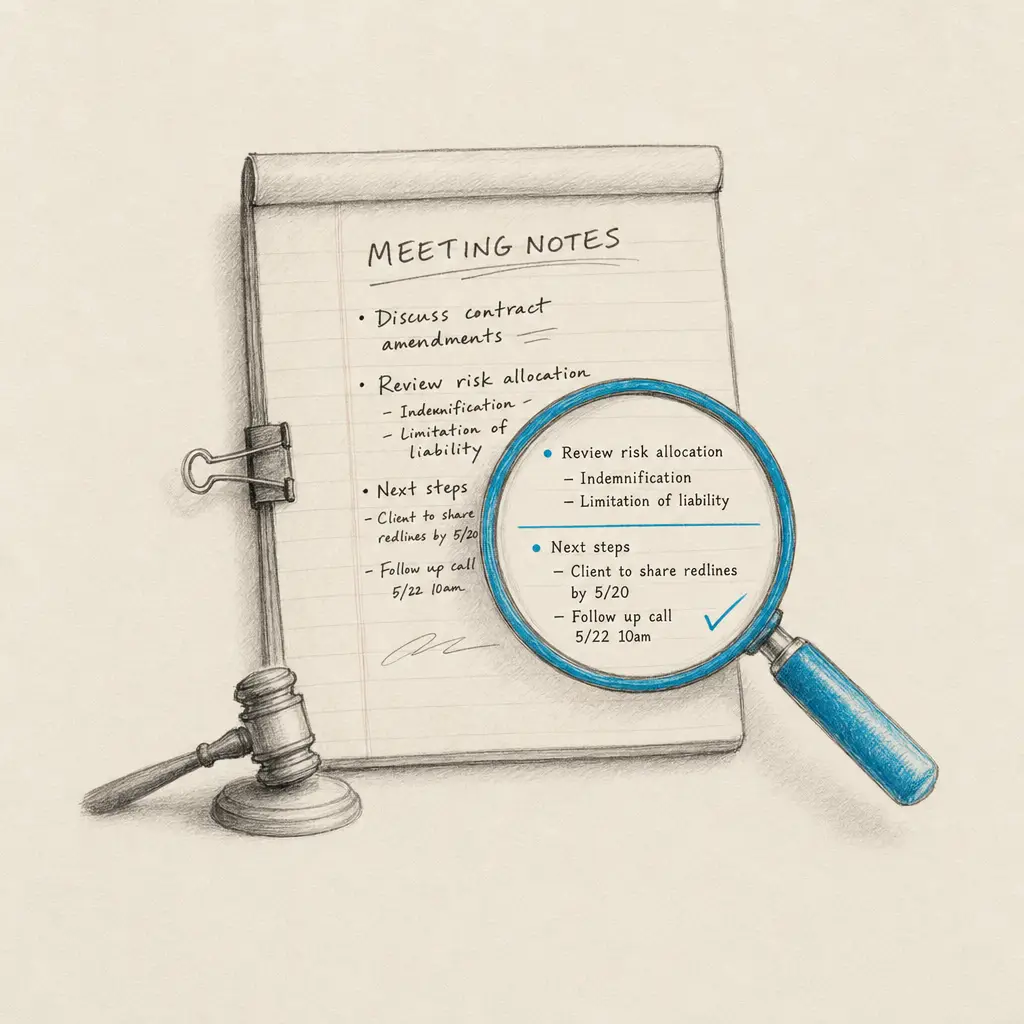
Legal professionals take handwritten notes during partner meetings, case strategy sessions, team discussions, and planning meetings. These notes document decisions made, action items assigned, strategic discussions, and case planning that shape firm operations and matter handling. Many attorneys prefer handwritten notes during meetings to maintain personal connection and avoid laptop barriers during collaborative discussions.
These handwritten meeting notes create practical problems for law firm operations. You cannot search years of meeting documentation to locate when specific decisions were made. When questions arise about case strategy or firm policies, finding relevant meeting notes means manually reviewing notebook volumes. Action items and decisions documented in handwritten form remain difficult to track and follow up. After meetings end, valuable documentation of legal work and firm management stays locked in physical notebooks rather than being searchable for operational needs.
This page explains how handwriting OCR makes legal meeting notes searchable and accessible. It addresses what types of handwritten meeting content it processes, how law firms use searchable meeting documentation, and realistic expectations when digitizing years of handwritten meeting records.
Why Legal Meetings Generate Handwritten Notes
Despite digital collaboration tools, many legal meetings still produce handwritten documentation. Understanding why helps clarify whether OCR technology addresses real firm management needs.
Partner and Leadership Meetings
Partner meetings address firm strategy, financial decisions, client conflicts, associate evaluations, and operational policies. These sensitive discussions often involve confidential financial information and personnel matters where handwritten notes feel more appropriate than typing.
Partners take handwritten notes during these meetings to document decisions, capture dissenting views, record action items, and maintain records of firm governance. The handwriting process allows focus on discussion rather than technology management.
These partner meeting notes document critical firm decisions that affect operations for years. Making them searchable enables efficient review of prior decisions, verification of policy rationales, and accountability for action item completion.
Law firm partners accumulate years of handwritten meeting notes documenting firm strategy and governance decisions that remain unsearchable until digitized.
Case Strategy and Team Meetings
Litigation teams meet to discuss case strategy, trial preparation, settlement positions, and tactical decisions. These meetings involve multiple attorneys sharing insights, debating approaches, and planning case handling.
Handwritten notes from strategy meetings capture the reasoning behind tactical decisions, document alternative approaches considered, and record team consensus on case direction. This documentation provides accountability and supports continuity when team members change.
Searchable strategy meeting notes enable attorneys to locate prior discussions about similar cases, find reasoning behind tactical decisions, or verify what approaches were considered and rejected. This supports both current case handling and future matters involving similar issues.
Client Development and Business Meetings
Law firms hold meetings about client development, marketing strategies, business planning, and practice area growth. These meetings produce notes about client relationships, referral sources, competitive positioning, and strategic initiatives.
Documentation from business meetings informs long-term planning and supports institutional knowledge about client relationships. When these notes are searchable, firms can locate discussions about client history, find strategic planning from prior years, or access observations about market conditions.
The Challenge of Unsearchable Meeting Documentation
Handwritten meeting notes accumulate over years of firm operations. Without searchability, this accumulated documentation remains difficult to access for decision-making and accountability.
Cannot Verify Historical Decisions
Years after meetings occur, questions arise about what was decided, why specific approaches were chosen, or what alternatives were considered. Partners might disagree about prior agreements, associates might question policy rationales, or clients might require explanations of strategic decisions.
Answering these questions from handwritten meeting notes requires manually reviewing notebook volumes to locate relevant discussions. Attorneys describe spending hours searching through old meeting notes to verify what was decided in prior partner meetings or case strategy sessions.
This verification inefficiency creates practical problems. Time spent searching for historical documentation is billable time not spent on client work. Important decisions might be implemented inconsistently because documentation cannot be efficiently located.
Lost Institutional Knowledge
Law firms benefit from institutional memory about clients, cases, and practice development. Meeting notes contain this knowledge, but when notes are handwritten and unsearchable, the knowledge remains effectively inaccessible.
An attorney might remember that a partner meeting addressed a specific client issue years ago but cannot locate the discussion in handwritten notes. Strategy sessions might have documented approaches that worked well on prior matters, but finding this information requires manual review of meeting notebooks.
Attorneys report knowing they documented important meeting discussions but being unable to locate them because handwritten notes cannot be searched efficiently.
Action Item Tracking Failures
Meetings produce action items that attorneys commit to completing. When these commitments are documented only in handwritten notes, tracking completion becomes manual work. Partners might forget what they committed to, associates might miss assignments, and follow-up becomes inconsistent.
Searchable meeting notes enable efficient action item tracking. Attorneys can search for all action items assigned to specific people, locate commitments made during particular meetings, or verify completion status of tasks decided months earlier.
What Handwriting OCR Processes in Meeting Notes
Handwriting recognition processes the types of content that appear in legal meeting documentation. Understanding what it handles helps determine whether it addresses firm workflow challenges.
Decision Documentation and Rationales
Meeting notes document decisions made, rationales discussed, and alternatives considered. These might include partner votes on firm policies, strategic choices about case handling, or consensus decisions about client management.
Handwriting OCR processes decision documentation including formal motions and votes, discussion of reasoning behind decisions, and documentation of dissenting views or concerns. It handles both structured meeting minutes and informal note-taking styles.
This means decision documentation becomes searchable. Firm administrators can locate when specific policies were adopted, attorneys can find reasoning behind prior strategic decisions, or partners can verify what alternatives were considered during important discussions.
Action Items and Assignments
Meeting notes contain action items assigned to specific attorneys, deadlines for task completion, and follow-up commitments. These assignments might be scattered through meeting notes rather than consolidated in organized lists.
The technology processes action item documentation including task descriptions, assigned attorney names, and deadline information. It recognizes common action item language like “follow up,” “research,” or “prepare memo.”
Searchable action items enable tracking of meeting commitments. Attorneys can search for their name to find all assignments, locate specific task descriptions to verify deadlines, or identify incomplete action items from prior meetings.
Strategic Discussions and Case Planning
Strategy meeting notes document legal analysis, case assessments, settlement evaluations, and tactical planning. These discussions represent attorney work product that informs case handling and demonstrates professional judgment.
Handwriting OCR processes strategic content including legal reasoning documented during meetings, case strength assessments and risk analysis, and tactical approaches debated by teams. It handles technical legal language and case-specific terminology.
This capability means strategic discussions become accessible for future matters. Attorneys can search for prior analysis of similar legal issues, locate case assessments that inform current strategic decisions, or find documented reasoning that supports current case approaches.
| Meeting Type | Typical Content | Access Challenge | Searchability Benefit |
|---|---|---|---|
| Partner meetings | Firm decisions, financial matters, policy | Cannot locate prior decisions or rationales | Search for policy adoption dates and reasoning |
| Strategy sessions | Case planning, tactical decisions | Cannot find prior similar case strategies | Locate strategic approaches for similar matters |
| Team meetings | Task assignments, deadlines | Cannot track action items efficiently | Search for all assignments and deadlines |
| Client meetings | Relationship notes, business development | Cannot access client history efficiently | Find prior discussions about clients |
| Practice group meetings | Area development, standards | Cannot verify practice guidelines | Locate documented practice standards |
How Law Firms Use Searchable Meeting Notes
Making meeting notes searchable addresses specific bottlenecks in law firm management and case work. Firms apply this capability to decision verification, action item tracking, and knowledge management.
Decision Verification and Policy Research
Firm administrators search meeting notes to verify when policies were adopted, locate reasoning behind strategic decisions, or understand historical context for current issues. Rather than manually reviewing years of partner meeting notes, they search for specific topics or dates.
This accelerates firm management. Questions about policy origins can be answered quickly with documented rationales. Disputes about prior decisions can be resolved through searchable meeting records. Changes to firm direction can be informed by understanding past strategic thinking.
Legal professionals describe using searchable meeting notes to research firm history, verify partner agreements, and ensure policy continuity. What might require days of manual notebook review becomes hours or minutes of targeted searching.
For broader context on legal handwriting, see the parent guide on legal notes handwriting OCR.
Searchable meeting notes enable law firms to locate specific decisions and policy rationales in minutes rather than days of manual review through partner meeting records.
Action Item Management and Accountability
Practice managers search meeting notes for action items to track completion, identify overdue tasks, or verify who committed to specific work. This supports accountability and ensures follow-through on meeting decisions.
With searchable notes, managers can locate all action items from specific meetings, find tasks assigned to particular attorneys, or identify patterns in incomplete assignments. This transforms meeting follow-up from manual tracking to systematic accountability.
Attorneys benefit from being able to search for their own action items across multiple meetings, verify what they committed to completing, and prioritize tasks based on documented deadlines.
Strategic Knowledge Sharing
Senior attorneys document valuable strategic insights during case meetings. When these insights are searchable, the entire firm benefits from shared knowledge about successful approaches, difficult legal issues, or effective tactics.
Associates can search strategy meeting notes for guidance on cases they are handling. Partners can locate successful approaches from prior matters. Practice groups can identify patterns in strategic decisions that inform practice standards.
This knowledge sharing improves firm-wide practice quality. Insights that would remain siloed in individual notebooks become searchable institutional knowledge.
Continuity During Attorney Transitions
When attorneys leave firms or transition between practice groups, meeting notes provide continuity. Searchable notes enable successors to understand prior decisions, locate case history, or access strategic planning that preceded their involvement.
This continuity supports smooth transitions. New matter attorneys can search prior meeting notes to understand case strategy, departing attorney responsibilities can be documented through searchable action items, and practice area knowledge can be transferred through accessible meeting documentation.
Realistic Expectations for Meeting Notes
Legal meeting notes vary in handwriting quality, organizational structure, and content formality. Understanding what handwriting OCR handles well and what requires attention helps set appropriate expectations.
What Works Well
Structured meeting formats with agendas and organized sections process effectively. When note-takers follow meeting agendas, use headings, and maintain organized documentation, OCR produces reliable results.
Standard legal and business terminology are recognized well. Terms attorneys use frequently in meetings, common action item language, and standard firm vocabulary process consistently even with moderate handwriting variation.
Notes written by designated note-takers with attention to legibility work effectively. When someone is assigned to document meetings and writes deliberately, the resulting notes support accurate text conversion.
What Requires Attention
Informal notes during fast-paced discussions may be less structured. When meetings involve rapid exchanges and note-takers write quickly to capture multiple speakers, handwriting and organization vary. These notes still benefit from OCR processing, but output may require more verification.
Personal abbreviations and firm-specific shorthand need interpretation. Law firms often develop internal terminology, abbreviations for frequent clients or matters, or shorthand for common discussions. While OCR converts handwriting to text, interpreting firm-specific language requires professional context.
Margin notes and informal additions may be less legible. When attorneys add observations or questions in margins during meetings, these annotations might be smaller or more rushed than primary notes.
Maintaining Work Product Protection
Legal meeting notes often constitute attorney work product protected from disclosure. Making notes searchable does not waive work product protection. The processing serves organizational purposes similar to creating meeting indexes or summaries.
Attorneys maintain professional responsibility for protecting work product and client confidential information in meeting notes. The service provides infrastructure to process notes confidentially, but attorneys make determinations about appropriate use under work product doctrine and ethical rules.
Privacy and Meeting Confidentiality
Legal meeting notes contain attorney work product, client confidential information, firm financial data, and personnel matters. These materials require confidential handling appropriate for sensitive legal content.
How Meeting Note Confidentiality Works
When you process legal meeting notes through handwriting OCR, materials are handled only to deliver results to you. They are not used to train AI models. They are not retained longer than necessary for processing. They are not shared with third parties or made accessible to other users.
This matters for meeting notes that contain attorney work product, client confidential information, and firm sensitive data protected by ethical rules and fiduciary duties. The service maintains protections appropriate for confidential legal materials throughout processing.
Your meeting notes remain under your control. You upload handwritten documentation, receive searchable text output, and maintain custody of both originals and processed results. The service does not claim rights to your work product or access it for purposes other than OCR processing.
Professional Responsibility Obligations
Attorneys and law firm personnel have ethical obligations regarding client confidentiality, work product protection, and firm information security. Using OCR services to digitize meeting notes does not eliminate these obligations.
The service provides infrastructure to handle legal materials confidentially, but firms make professional judgments about appropriate use under applicable ethical rules, privilege doctrines, and professional responsibility standards. Meeting notes remain subject to the same protections whether in handwritten or digitized form.
Security for Firm Materials
Legal meeting notes are transmitted and processed using security protocols appropriate for confidential legal materials. Documents are encrypted during transmission. Processing occurs in secure environments with access limited to systems necessary for OCR operations.
This infrastructure recognizes that legal meeting notes contain sensitive information requiring appropriate security. While no technology eliminates all risk, the architecture prioritizes security suitable for professional legal use with protected firm materials.
Getting Started with Legal Meeting Notes
If your firm maintains handwritten meeting notes and needs to make years of documentation searchable, the most direct approach is testing with your actual meeting records.
Meeting note-taking styles vary by firm, meeting type, and individual note-taker. Some firms maintain formal minutes while others keep informal notes. The only way to know whether handwriting OCR will work with your specific meeting documentation is testing it on actual pages from your firm.
HandwritingOCR offers a free trial with credits for processing sample documents. Upload pages from meeting notes with decision documentation, action items, or strategic discussions. See how the searchable output compares to your original handwritten records.
Your meeting notes remain confidential throughout testing. Documents are processed only to deliver results to you and are not used for any other purpose. This allows firms to test functionality while maintaining compliance with ethical obligations regarding client confidentiality and work product protection.
The service is straightforward to use. Upload scanned meeting note pages, process them, and download searchable text output. There is no complex setup, no software installation, and no commitment required to determine whether it works for your materials.
If it makes years of meeting documentation searchable and enables efficient decision verification or action item tracking, it likely delivers similar benefits on additional meeting records. If handwriting recognition accuracy does not meet your needs, you have learned that before investing further. Either way, you will understand whether handwriting OCR addresses practical challenges in managing your firm’s meeting documentation.
For additional context on processing other types of legal handwritten materials, see guides on lawyer notebooks, client interview notes, and case strategy notes. The broader context for legal handwriting appears in our guide to legal notes handwriting OCR.
Frequently asked questions
Can handwriting OCR process meeting notes with varying handwriting from different note-takers?
Yes, handwriting OCR processes meeting notes even when different people take notes at different meetings with varying handwriting styles. The technology adapts to individual handwriting characteristics and handles the variation across multiple note-takers. While consistency in note-taking supports better results, most legal meeting notes from different attorneys can be processed to create searchable documentation.
How does searchable meeting documentation help with decision verification?
Searchable meeting notes allow firms to quickly locate when specific decisions were made, what reasoning was discussed, and what alternatives were considered. Rather than manually reviewing years of partner meeting records, administrators can search for policy topics, decision dates, or specific issues. This enables efficient verification of firm decisions and provides documented rationales for current policies.
Are legal meeting notes kept confidential when processed through handwriting OCR?
Yes, legal meeting notes are processed only to deliver results to you and are not used to train AI models, shared with third parties, or retained longer than necessary. This protects attorney work product, client confidential information, and firm sensitive data in meeting documentation. Firms can process meeting notes while maintaining compliance with ethical obligations regarding confidentiality and work product protection.
Can handwriting OCR help track action items from legal meetings?
Yes, searchable meeting notes enable efficient action item tracking. Attorneys can search for their names to find all assigned tasks, locate specific action items to verify deadlines, or identify incomplete commitments from prior meetings. This transforms meeting follow-up from manual tracking to systematic accountability, ensuring that commitments documented in meetings are completed.
What file formats work for processing legal meeting notes?
Handwriting OCR processes scanned PDFs and image formats including JPG, PNG, and TIFF. Meeting notes can be scanned as multi-page PDFs, photographed as individual images, or captured using document scanning apps. All these formats work directly without conversion. The output is delivered as searchable text in formats like Word (DOCX) or plain text depending on firm workflow needs. There is no special preparation required beyond having scanned images of meeting note pages.