
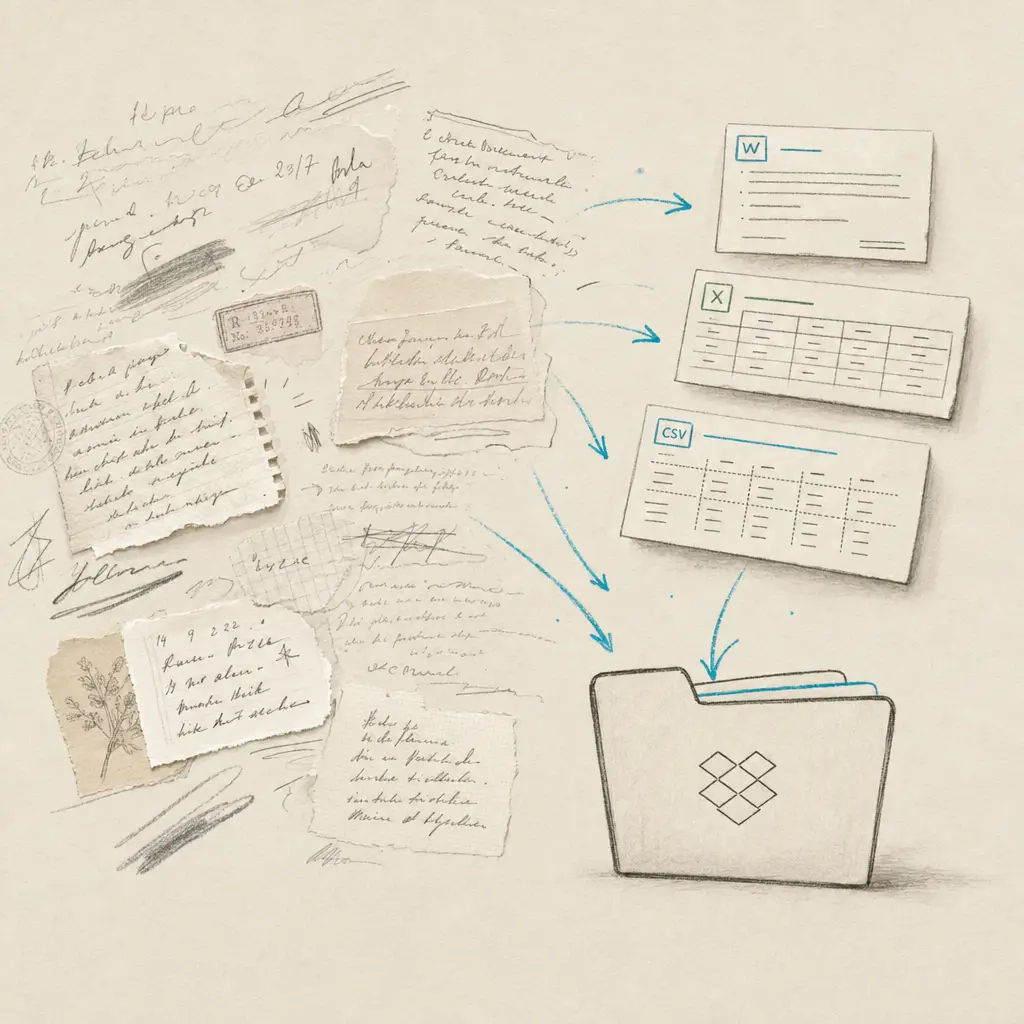
Dropbox folders often become the handoff point for scanned forms, field notes, handwritten surveys and archive material. The official Dropbox and Handwriting OCR integration on Zapier can process those files without someone repeatedly downloading, uploading and filing the results.
The two Dropbox workflows
Use the templates together for a complete round trip:
- Dropbox to Handwriting OCR: watch a selected folder and send each new supported PDF or image for processing.
- Handwriting OCR to Dropbox: watch for completed documents and save the downloadable result to a selected folder.
Each template is a two-step Zap. The intake workflow does not need a separate Zapier Filter step because Handwriting OCR checks the file extension before it calls the API.
Use separate input and results folders
Create two folders, for example:
Handwriting OCR - InputHandwriting OCR - Results
The intake Zap watches the first folder and the return Zap writes to the second. That makes the workflow easy to audit and prevents a returned result from being picked up as a fresh input.
Test with one small supported file before relying on a shared or client-facing folder.
Unsupported files stop before processing
The Handwriting OCR action accepts PDF, JPG/JPEG, PNG, TIF/TIFF, BMP, GIF, WebP and AVIF. If a PowerPoint, Word file, spreadsheet or another unsupported type appears in the watched folder, the Zap stops before the Handwriting OCR API upload. It does not create a failed document or use processing credits.
Return Zapier jobs or every completed document
The return template defaults to Zapier uploads only, which is the safest choice for a paired input-and-output workflow.
Choose All documents when Dropbox should be your central archive. That option can save results created through the dashboard, email inbox, API and other integrations as well.
Automatic formatting uses:
- Word (.docx) for transcription and translation;
- Excel (.xlsx) for table extraction;
- Excel (.xlsx) or CSV (.csv) for custom extractors.
Set up Dropbox handwriting OCR
- Open the Dropbox and Handwriting OCR templates.
- Connect your Dropbox and Handwriting OCR accounts.
- Choose a dedicated Dropbox input folder.
- Add the return template and choose a different results folder.
- Keep Document Source set to Zapier uploads only, unless you intentionally want every completed document.
- Test the round trip with one supported PDF or image.
Handwriting OCR uses one credit per processed page. New accounts include five trial credits, so you can test the workflow with your own handwriting before choosing a plan.
Connect Dropbox to Handwriting OCR on Zapier, create a Handwriting OCR account, or see all integrations.
Frequently asked questions
Can Dropbox automatically convert handwriting to text?
Yes. One two-step Zapier template watches a Dropbox folder and sends each supported file to Handwriting OCR. A second template saves completed results to the Dropbox folder you choose.
Does the Dropbox automation need a paid multi-step Zap?
No. Each direction is a two-step Zap. The Handwriting OCR action checks file extensions itself, so you do not need to add a separate Filter step.
What happens when an unsupported Dropbox file appears?
PowerPoint, spreadsheet and other unsupported file types stop inside the Handwriting OCR action before an API upload. No failed OCR document is created and no processing credit is used.
Which output formats can Dropbox receive?
Automatic output uses Word (.docx) for transcription and translation, Excel (.xlsx) for table extraction, and Excel (.xlsx) or CSV (.csv) for custom extractors.